How to Choose Between Straight-Through and Angle Globe Valves
In industrial pipeline systems, globe valves are key equipment used for controlling fluid shut-off and regulating flow. When engineers carry out valve selection, they often need to make a choice between straight-through globe valves and angle globe valves. Although both types of valves serve the same basic function—both can achieve throttling and isolation of media flow—due to differences in structural form, they show significant differences in pressure loss, installation space requirements, maintenance convenience, and system safety. This article will provide a detailed explanation of these two types of globe valves from four aspects: structural principles, performance characteristics, application scenarios, and selection recommendations, helping engineering personnel make reasonable choices according to actual requirements.
The straight-through globe valve is one of the most commonly used valve types in industrial pipelines. Its structure is simple and intuitive, its application history is long, and its technological maturity is high. In most conventional industrial scenarios, engineers usually first encounter this Z-type structured globe valve. The following sections explain its structure, working principle, performance characteristics, and application range in detail.
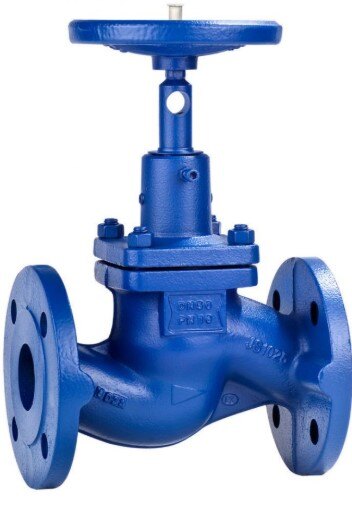
In a straight-through globe valve, the inlet and outlet are located on the same axis and arranged in a 180-degree opposite direction. Therefore, it is also known as a Z-type globe valve structure. The valve body is usually spherical or cylindrical in shape, and internally it contains a valve seat and a valve disc.
When the operator rotates the handwheel, the valve stem drives the valve disc to move in a vertical linear motion. When the valve disc moves downward and tightly presses against the valve seat, the flow passage is cut off and the valve is closed; when the valve disc moves upward, the flow passage gradually opens and the medium begins to pass through.
The internal flow channel of this type of valve is in a bent or S-shaped path. After entering from the inlet, the fluid must undergo several directional changes before reaching the outlet. The sealing between the valve disc and valve seat adopts a linear contact sealing method, and reliable sealing is achieved through precise machining and matching. Valve body materials are usually cast steel, stainless steel, or brass. The valve seat surface is often hardened with wear-resistant alloys to improve erosion resistance.
The biggest advantage of the straight-through globe valve lies in its symmetrical structure and clear flow path. Its manufacturing and maintenance processes are mature and widely standardized. Because the inlet and outlet are aligned in a straight line, the upstream and downstream pipelines can maintain a straight layout, making installation logic intuitive and system analysis relatively easy.
In terms of flow regulation, the straight-through globe valve offers good control accuracy. By adjusting the opening between the valve disc and valve seat, continuous and precise flow regulation can be achieved. Therefore, it is suitable for applications with relatively high flow control requirements. It also has good sealing performance and can withstand relatively high pressure and temperature conditions. It is applicable to a wide range of media such as liquids, gases, and steam.
However, this type of valve also has certain limitations. Since the fluid needs to change direction multiple times inside the valve body, it generates relatively large turbulence and pressure loss. As a result, the system pumping energy consumption is higher. In addition, the spherical valve body occupies a relatively large installation space, which may be restrictive in compact layouts. Furthermore, because it contains more components, long-term maintenance frequency and cost may also be relatively higher.
Straight-through globe valves are suitable for conventional industrial systems with sufficient space and regular pipeline layouts. They are widely used in petroleum refining, petrochemical industries, power generation, water treatment, and steam pipeline networks. Especially in high-pressure pipeline systems that require precise flow regulation and high sealing performance, this type of valve demonstrates stable and reliable operation.
In horizontal straight pipe sections, straight-through globe valves are convenient for maintenance personnel to operate and inspect from multiple directions, which also contributes to their wide application in traditional industrial systems.
Unlike straight-through structures, the angle globe valve integrates the pipeline turning function directly into the valve body, forming a 90-degree inlet-outlet configuration. The core idea of this design is to achieve flow control while simplifying external pipeline layout as much as possible, providing a more compact solution for space-constrained engineering environments. The following explains its structure, features, and applications in detail.
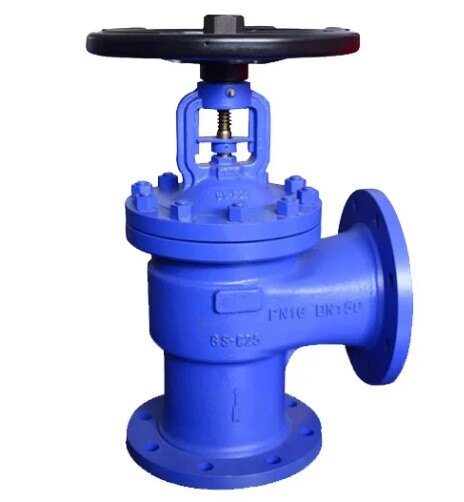
The inlet and outlet of the angle globe valve are arranged at a 90-degree angle. When the fluid passes through the valve, it completes a directional change inside the valve body.
The internal mechanism still relies on the vertical movement of the valve disc to achieve opening, closing, and throttling functions. However, the flow channel design integrates the turning function into the valve body itself.
When the valve is open, the medium enters from one port, changes direction inside the valve body, and then exits from the other port. This design allows a single angle globe valve to simultaneously perform flow control and pipeline direction change, eliminating the need for an additional elbow fitting.
The most prominent feature of the angle globe valve is its compact structure. In space-restricted environments such as machine rooms, skid-mounted systems, or compact industrial layouts, it significantly saves installation space.
Since it combines the functions of a globe valve and an elbow, it reduces one pipe fitting and two welding joints. This leads to reduced material usage and lower installation labor costs.
From a system safety perspective, fewer welding points mean fewer potential leakage risks, which is especially important under high-pressure and high-temperature operating conditions. At the same time, reducing pipe fittings also helps reduce stress concentration and improves system stability in high vibration or pulsating flow environments.
From a fluid mechanics perspective, the angle globe valve only involves a single 90-degree directional change inside the body. Compared to straight-through valves, its overall flow resistance is generally lower. Lower pressure loss helps reduce pumping energy consumption and also decreases erosion on the valve disc and seat, extending service life in applications involving particulate media or high-temperature steam.
In terms of maintenance, the bonnet structure usually extends outward, allowing easy disassembly of internal components such as the stem and valve internals. However, sufficient vertical space must be reserved during design to allow packing replacement and maintenance operations.
Angle globe valves are particularly suitable for space-limited applications and systems requiring directional changes. They are commonly used in boiler feedwater systems, heater drainage systems, marine piping systems, and compact industrial equipment.
When the pipeline system itself requires a 90-degree turn, using an angle globe valve can eliminate the need for additional elbow fittings and simplify the overall piping layout. For engineering projects that require compact design and reduced installation complexity, this type of valve is often a better choice.
After understanding the characteristics of straight-through and angle globe valves, engineers often need a quick comparison when making selection decisions. The following compares the two types from structure, flow performance, maintenance, and system safety perspectives.
Straight-through globe valves have inlet and outlet aligned on the same axis, requiring straight pipeline installation. This is convenient in open layouts but requires additional elbows when directional changes are needed, increasing fittings and complexity.
Angle globe valves have a 90-degree inlet-outlet configuration and can directly replace elbow fittings. This makes pipeline design more compact and reduces the number of components required. In system design terms, one angle globe valve can replace a straight valve plus an elbow combination.
Straight-through globe valves have a more complex internal flow path. The fluid undergoes multiple directional changes, resulting in strong turbulence and higher pressure loss. This increases pumping energy consumption over long-term operation.
Angle globe valves complete flow direction change within the valve body in a more streamlined manner. Although local pressure loss still exists, overall resistance is generally lower than straight-through valves. In high-flow steam systems or energy-sensitive applications, the efficiency advantage of angle valves becomes more obvious.
Straight-through globe valves have symmetrical structures and good alignment between disc, seat, and stem, providing stable long-term performance. In horizontal pipe sections, maintenance access is relatively convenient.
Angle globe valves are more compact and require higher installation precision. However, by reducing external elbows and welds, the overall system may actually require fewer maintenance points. In long-term continuous operation environments, fewer fittings often mean fewer potential failure points.
In high-temperature and high-pressure systems, every welded joint is a potential risk point. Straight-through systems with elbows generally have more connections.
Angle globe valves reduce the number of welds and fittings, thereby lowering the risk of leakage and improving overall system safety. Fewer external fittings also reduce pipeline vibration and stress concentration.
When selecting between straight-through and angle globe valves, engineers should consider the following factors:
- Space conditions: Evaluate installation space. If piping is linear and space is sufficient, choose straight-through valves. If space is limited or directional change is required, choose angle valves.
- Pressure loss requirements: For systems sensitive to pressure drop, lower resistance is preferred. Angle globe valves usually perform better.
- Media characteristics: Consider temperature, pressure, corrosion, and solid particles. Reducing connection points is especially important under harsh conditions.
- Maintenance accessibility: Ensure sufficient operating space for stem movement and maintenance activities.
- Cost factors: Evaluate not only purchase cost but also installation, welding, energy consumption, and maintenance costs. Angle valves may have higher unit cost but can reduce overall system cost.
For conventional straight pipeline systems with sufficient space and standardized layouts, straight-through globe valves remain a reliable and safe choice. Their mature manufacturing process and high compatibility make them widely used in petroleum, chemical, and power industries.
For space-constrained systems or those requiring compact layouts, angle globe valves offer clear advantages. They are widely used in boiler systems, heater pipelines, marine engineering, and skid-mounted equipment.
Straight-through globe valves and angle globe valves are not substitutes for each other but optimized solutions for different engineering requirements. Straight-through valves are suitable for conventional systems requiring stable flow regulation, while angle globe valves are ideal for compact systems and pipeline direction changes.
A proper understanding of their structural differences and performance characteristics helps engineers optimize pipeline design, reduce installation complexity, minimize leakage risks, and improve overall system reliability and economic efficiency. In practical selection, it is recommended to evaluate real operating conditions carefully and consult manufacturers to ensure long-term stable performance.
