Pressure Seal Globe Valve: A High-Pressure Sealing Solution
In modern industrial systems, the transportation of high-pressure, high-temperature, and hazardous media has become a common operating condition in industries such as power generation, petrochemicals, natural gas, and nuclear energy. As industrial facilities continue to expand in scale and system operating parameters keep increasing, traditional valves are increasingly exposed to problems such as sealing failure, gasket aging, and bolt loosening under extreme service conditions. Once leakage occurs, it can not only cause equipment damage and energy loss, but may also lead to severe safety incidents including fire, explosion, or environmental pollution. Therefore, achieving long-term, stable, and reliable zero-leakage sealing under ultra-high-pressure and high-temperature conditions has become a critical issue in industrial piping system design.
Pressure seal globe valves were developed precisely in response to these challenges. Through a unique self-tightening sealing structure, these valves utilize the internal system pressure itself to enhance the sealing effect, enabling more stable sealing performance under high-pressure conditions. Compared with conventional bolted bonnet globe valves, pressure seal globe valves not only provide stronger pressure-bearing and temperature-resistant capabilities, but also significantly reduce maintenance frequency and improve overall system operating safety. As a result, they are widely used in various high-risk and high-parameter industrial installations.
A pressure seal globe valve is an industrial valve specifically designed for high-pressure and high-temperature environments. Its primary function is to control the flow of fluid within a pipeline while ensuring that the medium does not leak from the valve connection area. These valves are widely used in ultra-high-pressure steam systems, hazardous chemical transport pipelines, and other high-risk industrial applications.
Unlike conventional valves, pressure seal globe valves adopt a special tapered bonnet design. This design relies on precise metal-to-metal contact to create the seal rather than using bolts to compress a gasket as ordinary valves do. When the internal system pressure rises, the force of the medium itself pushes the bonnet more tightly against the valve body, producing a self-enhancing sealing effect.
This type of valve can maintain zero-leakage performance under high-pressure conditions exceeding 1500 psi (approximately 103 atmospheres). At the same time, it can withstand severe temperature fluctuations and long-term thermal shock. Because of these characteristics, pressure seal globe valves are extensively used in industries with extremely high safety requirements, including power generation, petrochemicals, and nuclear power.
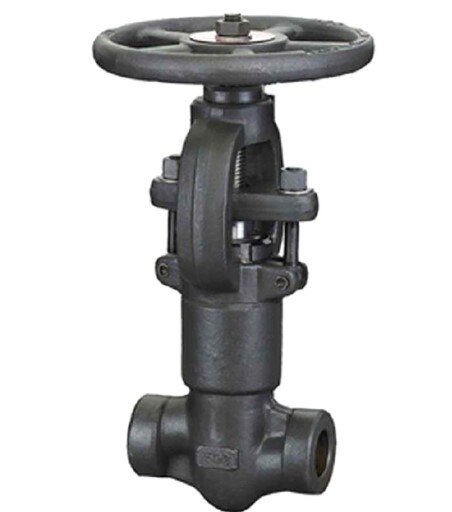
The basic operating method of a pressure seal globe valve is similar to that of a conventional globe valve. The operator drives the valve stem upward or downward through a handwheel or actuator. The stem moves the valve disc into contact with or away from the valve seat, thereby opening or closing the valve.
However, there are significant differences between pressure seal globe valves and ordinary valves in terms of sealing structure. In conventional globe valves, the bonnet and valve body are connected through a flanged structure. Multiple bolts compress a gasket to achieve sealing. Under high-pressure and high-temperature conditions, this structure is prone to problems such as bolt loosening, gasket aging, and creep deformation, resulting in a relatively high leakage risk during long-term operation.
Pressure seal globe valves, by contrast, achieve sealing through a metal tapered compression structure. The tapered component on the bonnet compresses the packing between the valve stem and valve body, while an independent gasket seals the connection surface between the upper and lower body sections. This multi-barrier design effectively prevents leakage caused by bolt loosening.
Because extremely high machining precision is required, the clearance between the valve stem and bonnet is controlled with great accuracy. This prevents galling between metal components at high temperatures, allowing the valve to maintain smooth operation even during frequent opening and closing cycles. With this design, valve leakage can be reduced to an extremely low level, and some products can even achieve leakage rates measured only at the molecular level per year.
The overall structure and working principle of pressure seal globe valves have already been introduced, but another critical detail directly affects valve service life: how the fluid flows inside the valve. Many field failures are not caused by sealing failure, but rather by unreasonable internal flow passage design, which allows high-speed fluid to erode the valve seat and disc. This section focuses on analyzing the influence of flow passage structure on valve performance.
The internal flow passage structure of a pressure seal globe valve determines how fluid moves under extreme high-pressure conditions. The geometric design of the flow passage directly affects fluid velocity control, erosion risk on internal valve components, and long-term operational reliability.
In high-pressure pipeline systems, fluids usually flow at very high speeds, especially in steam or superheated media environments. High-speed flow generates strong turbulence inside the valve body, which in turn causes vibration, noise, and uneven pressure distribution. These effects continuously impact the valve seat, valve disc, and inner wall of the valve body, eventually leading to wear or even material erosion after long-term operation.
At the same time, high-temperature environments weaken the mechanical properties of certain metallic materials. The combined effects of high pressure and high temperature place much higher demands on valve structural design. Therefore, industrial globe valves must optimize internal flow passages to effectively guide the fluid, thereby reducing destructive turbulence and improving overall stability.
In practical engineering applications, pressure seal globe valves mainly adopt two types of flow passage structures. The choice depends on specific operating conditions.
The first is the Y-pattern structure. In this design, the valve stem and valve seat are arranged at a certain angle, creating a smoother fluid path and reducing pressure loss caused by abrupt directional changes. Fluid passes through the valve body in a more stable manner, helping reduce turbulence under high-pressure conditions while improving flow efficiency. Y-pattern structures are commonly used in globe valves for high-pressure steam systems.
The second is the improved straight-through structure. This design optimizes the internal flow passage based on the traditional valve body configuration. By adjusting the valve seat angle and cavity shape, the fluid can gradually change direction, avoiding erosion problems caused by sharp turns. The core objective of both structures is the same: to achieve a smoother fluid flow process while maintaining sealing performance, thereby extending valve service life. The specific structure selected depends on operating conditions such as pressure rating, flow velocity, and medium temperature.
Even when the correct flow passage structure is selected, localized high-velocity regions still exist inside the valve and require special attention. Understanding velocity distribution helps ensure proper valve selection and maintenance planning.
The geometry of the valve directly affects fluid velocity distribution inside the valve. In high-pressure systems, the incoming fluid already possesses high kinetic energy. When the flow direction changes, local fluid velocity may increase further. Areas such as the valve seat opening, throttling throat, and outlet cavity often become acceleration zones where pressure decreases while velocity rises. If the structural design is unreasonable, local velocity peaks can cause severe erosion damage to metal surfaces.
To control this phenomenon, valve designs usually adopt smooth transitional cavity structures that allow the fluid to gradually change direction, thereby reducing turbulence intensity and maintaining flow stability. In industrial systems such as power plants, this type of flow passage optimization can effectively reduce wear on critical sealing components and ensure long-term valve reliability.
Under high-temperature conditions, erosion problems become even more severe. High-speed steam gradually strips material from the metal surfaces inside the valve, making the valve seat, disc edges, and downstream inner wall of the valve body the primary wear areas. Long-term operation may result in pitting or wall thinning. Reasonable flow passage design can significantly reduce sudden local velocity changes and therefore minimize the risk of damage in these high-stress regions. Pressure seal globe valves are usually structurally reinforced in high-impact areas to improve durability in high-temperature steam environments.
In addition to structural design, valve performance is influenced by many other factors. These factors interact with one another and collectively determine valve performance under actual operating conditions.
In terms of material selection, high-temperature alloy materials provide better resistance to erosion. Regarding valve size, larger valves create higher requirements for flow rate and velocity control. In terms of manufacturing precision, the higher the machining accuracy, the smoother the internal surfaces and the lower the fluid resistance, which helps maintain stable flow conditions. The coaxial accuracy between the valve stem and valve seat also directly affects sealing performance and operational smoothness. When these factors are combined with a well-designed internal flow passage, the valve can maintain stable and reliable operating performance even under extreme high-pressure and high-temperature conditions.
The previous sections comprehensively introduced pressure seal globe valves from the perspectives of definition, working principle, application fields, and internal flow passages. So compared with ordinary globe valves, what exactly makes them superior? Why are users willing to pay more for this type of valve? This section explains the three most important advantages.
The most prominent advantage of pressure seal globe valves is their exceptional sealing performance. In high-pressure systems, even extremely small leakage can cause serious consequences such as medium loss, environmental pollution, or safety accidents. Through the self-tightening sealing mechanism, the pressure seal structure maintains stable sealing performance under high-pressure and high-temperature conditions, effectively preventing leakage problems.
These valves typically adopt metal-to-metal sealing structures, enabling them to maintain excellent sealing performance in corrosive media, high-speed fluid erosion, and high-temperature environments. These characteristics make them particularly suitable for demanding operating conditions in oil and gas production, chemical processing, and power plant systems.
Because system pressure itself participates in the sealing process, the additional load acting on sealing components is effectively reduced. This means that seal wear is slowed, service life is extended, and maintenance frequency is reduced accordingly. At the same time, the elimination of external bolt structures avoids leakage risks caused by bolt fatigue or loosening, allowing the valve to maintain higher operational stability during long-term service.
Pressure seal globe valves are usually manufactured from high-strength materials such as forged steel or stainless steel. These materials possess excellent mechanical properties and corrosion resistance, enabling the valve to maintain structural integrity and stable performance in high-pressure, high-temperature, and corrosive environments.
Due to their unique self-enhancing sealing structure, pressure seal globe valves can withstand higher pressure ratings than traditional bolted bonnet globe valves. This makes them suitable for critical applications such as long-distance oil and gas pipelines, power station boiler systems, and high-pressure chemical processing units.
In terms of temperature resistance, metal sealing structures provide much better thermal stability than traditional gasket seals. Metallic materials can effectively resist the effects of thermal expansion and contraction, unlike non-metallic gaskets that may creep or age during thermal cycling. Therefore, in high-temperature steam systems, pressure seal globe valves offer clear advantages and can maintain reliable long-term operation under frequent thermal cycling conditions.
After understanding the working principle, a natural question arises: where exactly are these valves used, and why are ordinary valves insufficient while pressure seal globe valves are suitable? In reality, pressure seal globe valves are not required in every application. They truly demonstrate their irreplaceable value only in systems involving hazardous media, harsh operating conditions, and severe leakage consequences. The following are the four primary application areas.
In chemical production, pipelines frequently transport corrosive acids, alkaline liquids, catalysts, and volatile organic compounds. Once leakage occurs, these media may harm operators, pollute the environment, and cause safety incidents. The zero-leakage characteristics of pressure seal globe valves make them critical equipment in chemical plants, effectively isolating hazardous media and ensuring production safety.
During oil and gas extraction and transportation, media are often under high-temperature and high-pressure conditions and are highly flammable and explosive. Pressure seal globe valves can operate safely under these harsh conditions and rapidly shut off fluid flow in emergencies to prevent accidents.
In thermal power plants and industrial boiler systems, steam temperature and pressure are extremely high. Under conditions exceeding 800°F (approximately 427°C) and 1500 psi, the packing structures of ordinary valves are prone to failure. Pressure seal globe valves, however, can withstand such ultra-high-temperature and ultra-high-pressure steam cycle operation while maintaining long-term sealing reliability.
Feedwater systems, steam systems, and safety injection systems in nuclear power plants all require highly reliable valves. The isolation of radioactive media demands absolute sealing, and any leakage could lead to severe nuclear safety incidents. The zero-leakage performance of pressure seal globe valves fully satisfies the strict requirements of the nuclear power industry.
Through the detailed analysis presented in the five sections above, one clear conclusion can be drawn: the pressure seal globe valve is a specialized valve product designed specifically for high-pressure and high-temperature operating conditions. Its core value lies in solving the leakage problems commonly encountered by traditional valves under severe service environments through a self-tightening sealing mechanism.
With its unique tapered bonnet and self-tightening sealing structure, the valve can maintain zero-leakage performance under conditions exceeding 1500 psi pressure and 800°F temperature. It is suitable for high-risk industrial fields such as chemical processing, oil and gas, power generation, and nuclear energy. In terms of internal flow passage design, the adoption of Y-pattern structures or improved straight-through structures, combined with smooth transitional cavity designs, effectively controls fluid turbulence and local velocity peaks, reducing erosion and wear risks. At the same time, the use of high-temperature alloy materials and high-precision manufacturing processes further improves valve durability and reliability.
Overall, when selecting valves for high-pressure and high-temperature applications, engineers should fully consider the technical advantages of pressure seal globe valves. Although their initial procurement cost may be higher than that of ordinary globe valves, they are often a more economical choice in terms of long-term operational safety, maintenance frequency, and service life. For industrial systems that must handle hazardous or critical media under extreme pressure and temperature conditions, pressure seal globe valves are highly reliable solutions worthy of priority consideration.
