Wedge Gate Valve vs. Slab Gate Valve: How to Make a Choice
In industrial pipeline systems, gate valves are among the most widely used isolation valves. Depending on sealing structures and gate configurations, gate valves can be broadly categorized into wedge gate valves and slab gate valves. While these valves may appear similar externally, they differ significantly in operating principles, performance characteristics, and optimal application scenarios. Understanding these differences of the two gate valves is critical for proper engineering selection, ensuring system safety, and optimizing maintenance efforts.
The defining feature of a wedge gate valve is its wedge-shaped gate and seat surfaces. These inclined surfaces form a specific angle relative to the valve’s centerline, commonly 3° or 5°, with other specifications ranging from 2°52′ to 10°. This wedge angle ensures that, during closure, the gate is pressed into the seats with a mechanical wedging action, producing a forced metal-to-metal seal.
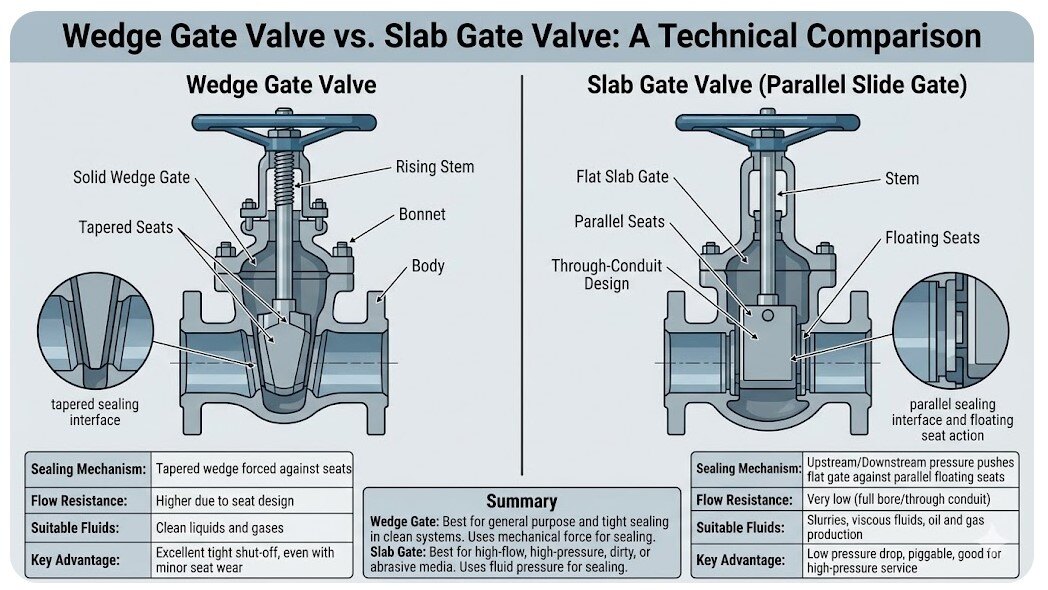
The solid wedge design is the simplest form, with fewer components and high structural reliability. However, because sealing relies on a single rigid disc, it requires extremely high machining precision on the sealing faces. Even slight angular deviations can compromise the sealing performance. In high-temperature applications, thermal expansion may cause the gate to stick, reducing adaptability to temperature fluctuations.
The flexible wedge design incorporates elasticity into the gate structure, allowing slight deformation. This compensates for machining inaccuracies and thermal expansion, significantly reducing the risk of thermal binding while retaining the simplicity of the solid wedge design. It is currently the most widely used wedge gate valve type.
The split wedge features two discs connected by a spring or spreading mechanism. This design is commonly used in water and steam systems. It is more tolerant to sealing surface angular deviations, as the internal mechanism allows self-adjustment. Wear can be compensated by replacing spacers, extending service life. However, the increased number of components introduces complexity. Sticky or viscous media may cause the discs to adhere, and long-term exposure may lead to corrosion of the limiting mechanism, creating a risk of disc detachment.
Wedge gate valves utilize metal-to-metal hard sealing. During closure, the valve stem pushes the gate downward. As thrust increases, pressure between the wedge-shaped sealing surfaces rises progressively, resulting in a tight forced seal. This self-enhancing characteristic ensures effective sealing even at low pressures, a key advantage of wedge gate valves.
During opening, the gate lifts quickly from the seats, minimizing friction time and reducing wear. However, due to a cavity at the bottom of the valve body, media can accumulate when the valve is open, making wedge gate valves generally unsuitable for pigging operations.
Operational torque is higher due to the wedging action. Electric actuators typically require torque switches to control sealing force and prevent overload damage.
Slab gate valves, also known as flat gate valves or conduit gate valves, feature parallel sealing surfaces aligned with the pipeline axis. The gate slides vertically between the seats without any wedging action, reducing friction and simplifying operation.
Slab gate valves can be designed with either single-gate or double-gate configurations.
Single-gate slab valves rely on medium pressure to push a floating gate or seat against the opposite sealing surface. Flow from one side forces the gate toward the downstream seat, forming a unidirectional seal. While compact, the bidirectional sealing capability is limited.
Double-gate slab valves employ two discs connected by a spring or spreading mechanism. This ensures reliable sealing in either flow direction, providing true bidirectional sealing. Double-gate configurations are the mainstream form for slab gate valves.
A critical feature of slab gate valves is full-bore (piggable) design. When fully open, the valve bore aligns completely with the pipeline, forming a straight-through flow path. This minimizes flow resistance (coefficient as low as 0.15) and pressure drop, making slab gate valves ideal for pipelines requiring pigging.
Sealing in slab gate valves is primarily achieved through medium pressure or spring force. When closing, the gate maintains continuous contact with the seat, with relatively low contact pressure. Medium pressure pushes the floating gate or seat toward the opposite side, producing a reliable seal.
No wedging force is involved, so operating torque is significantly lower than wedge gate valves, often reduced by 50%. Electric actuators only require travel switch control, simplifying system logic.
Because the gate and seat maintain contact throughout the stroke, slab gate valves exhibit self-cleaning characteristics. Solid particles in the medium are pushed aside or carried away, preventing particle embedding and prolonging service life—particularly advantageous in particle-laden media.
Understanding structural differences allows us to compare wedge and slab gate valves across multiple performance metrics.
Wedge gate valves rely on mechanical wedging to generate high contact pressure. They maintain effective sealing under high differential pressures (exceeding 10 MPa). Hard-faced sealing surfaces (e.g., cobalt-chromium alloys) provide high wear resistance. However, repeated separation during operation may allow solid particles to embed, potentially causing leaks.
Slab gate valves use floating seals with soft-hard combinations (e.g., O-rings and metal surfaces) and grease injection systems. They achieve zero-leakage standards and superior bidirectional sealing. However, under extremely low pressures, sealing may be less effective than wedge gate valves.
Thermal binding is a key concern for wedge valves. High temperatures can cause the gate to expand and jam. Flexible and split wedge designs mitigate this, enabling operation from -29°C to 550°C.
Slab gate valves’ floating gates inherently accommodate thermal expansion. Gates slide freely regardless of temperature, avoiding binding. Typical operating ranges are -46°C to 120°C, with special materials required for cryogenic service.
Wedge gate valves perform best with clean media (e.g., natural gas, LPG, steam). Particulate-laden media may damage sealing surfaces during gate separation. Accumulated debris in the bottom cavity requires periodic cleaning.
Slab gate valves maintain continuous gate-seat contact, providing self-cleaning ability, making them suitable for media containing sand or suspended solids (≤50 mg/L). Particle embedding is minimized, enhancing longevity.
Wedge gate valves have higher flow resistance due to non-straight flow paths and bottom cavities that impede pigging. Slab gate valves provide a straight-through bore when fully open, minimizing flow resistance and enabling pigging operations without stopping pipeline service.
Wedge gate valves require more frequent maintenance due to thermal binding and sealing wear. Rising stem designs expose the stem to environmental corrosion, and debris accumulates in the body cavity.
Slab gate valves often include stem covers, position indicators, and grease injection systems for dynamic sealing. Wear is minimized, and maintenance intervals are approximately 30% longer than wedge gate valves.
Based on the above comparison of sealing performance, temperature adaptability, and medium adaptability, it is clear that wedge gate valves and slab gate valves each have their own technical advantages and application boundaries. These performance differences are not only due to structural design but are also closely related to manufacturing standards and material selection.
Wedge gate valves commonly adhere to API 600, covering design, pressure rating, material requirements, and testing for high-pressure industrial applications.
Slab gate valves typically follow API 6D, focusing on pipeline valves, sealing reliability, and piggable designs for long-distance pipelines. Both types may also involve ASME B16.34 (general valve requirements), API 598 (inspection and testing), and regional standards like GB/T, DIN, and JIS.
Slab gate valves are usually made of stainless steel or carbon steel to resist abrasion and handle dense media. Corrosive environments may require 316 stainless steel, duplex stainless steel, or linings. Sealing surfaces often combine soft materials (PTFE, rubber) with metal for dual sealing.
Wedge gate valves, designed for high sealing pressures and temperatures, are typically alloy steel (WC6, WC9, C5). Sealing surfaces are hardened or hard-faced with cobalt alloys or tungsten carbide to resist wear and high temperatures.
Proper material selection reduces wear, extends service life, and prevents unexpected failures. Consider media properties, temperature and pressure, and economic constraints.
After clarifying performance differences, standards, and material requirements, the key lies in translating these technical parameters into practical selection decisions. Different industrial scenarios have completely different functional requirements for valves—some prioritize sealing reliability under extreme conditions, others emphasize long-term operational economy, and some must accommodate special operations such as pigging.
- High-pressure, high-temperature pipelines: Supercritical power plant steam (≥25 MPa, ≥540°C), refinery catalytic cracking units.
- Systems requiring absolute sealing: LNG storage, nuclear isolation valves, toxic media pipelines.
- Low differential pressure isolation: Mechanical wedging ensures reliable sealing even at low pressures.
- Erosion/cavitation resistance: Wedge geometry outperforms flat gates in aggressive flow.
Long-term isolation: Backup pipelines or safety system isolation valves requiring rarely operated but reliable sealing.
- Long-distance pipelines: Large-diameter natural gas and crude oil pipelines, minimizing energy loss due to low flow resistance and enabling pigging.
- Particle-laden media: Oilfield produced fluids, slurry, wastewater—self-cleaning reduces wear.
- Bidirectional systems: City gas stations, chemical pipelines with multiple media.
- Frequent operation: Metering or distribution stations—low torque reduces actuator cost and extends life.
- Maintenance-sensitive locations: Subsea pipelines, remote areas—longer maintenance cycles.
- Cryogenic conditions: LNG or air separation units—floating gate prevents low-temperature binding.
- Media characteristics: Slab gates preferred for particulate media.
- Pressure-temperature conditions: Wedge gates for high pressure/temperature; slab gates for low pressure or variable temperature.
- Operation frequency: Slab gates for frequent use; wedge gates for long-term isolation.
- Pigging requirement: Full-bore slab gates required.
- Space constraints: Slab gate (especially non-rising stem) saves installation height.
- Cost considerations: Slab gates often reduce actuator and maintenance costs, lowering lifecycle cost.
- Standards compliance: Specific industries may mandate valve types (e.g., pipelines, nuclear).
Wedge and slab gate valves are the two dominant types in industrial pipeline systems, each with unique advantages. Wedge gate valves, with forced sealing and high-pressure/high-temperature performance, are indispensable under severe conditions. Slab gate valves, with low flow resistance, self-cleaning, and low maintenance requirements, excel in long pipelines and particle-laden media.
In practice, neither type is universally superior. Optimal selection depends on media characteristics, operational conditions, maintenance resources, and cost. A thorough understanding of valve structure, performance, and application ensures safe, efficient, and cost-effective pipeline operation over the long term.