Comparison of V Type Ball Valves and O Type Ball Valves
In industrial pipeline systems, ball valves, as an important control component, are widely used for shut-off, distribution, and regulation of various fluid media. Among them, V Type Ball Valves and O Type Ball Valves are two common types of ball valves, each with unique structural features and performance advantages, suitable for different working conditions. This article provides a detailed comparison of V Type Ball Valves and O Type Ball Valves from multiple aspects to help users better select the appropriate ball valve products.
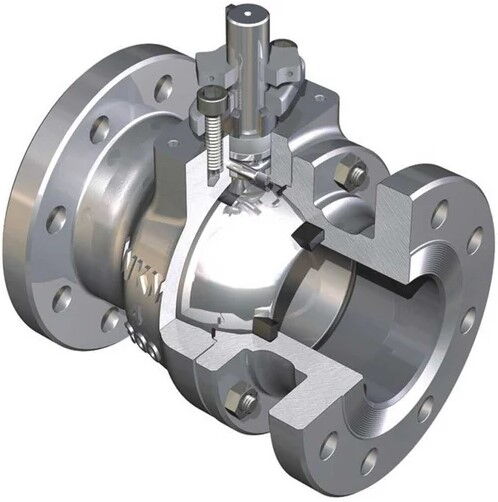
O Type Ball Valve: The O Type Ball Valve has a ball with a central bore installed inside the valve body. The bore has a diameter equal to the pipeline diameter. The ball can rotate within the sealing seat, and there is an annular elastomer on each side in the pipeline direction to achieve sealing. When the ball is rotated 90°, the direction of the bore changes accordingly, realizing the opening and closing of the ball valve. O Type Ball Valves adopt floating or fixed designs. All relative moving parts use self-lubricating materials with extremely low friction, resulting in low operating torque. In addition, the long-term sealing of grease makes operation more flexible.
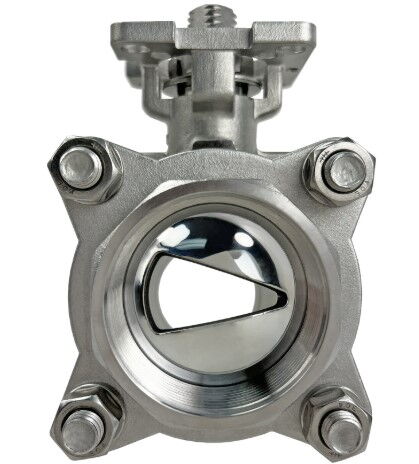
V Type Ball Valve: The V Type Ball Valve features a ball core with a V-shaped structure. The valve core is a 1/4 ball shell with a V-shaped notch. It has high flow capacity, a wide adjustable range, shearing ability, and tight shut-off, making it particularly suitable for working conditions where the fluid contains fibrous material. V Type Ball Valves are generally single-seal and not suitable for bidirectional use. During ball rotation, the V-shaped edge of the ball core cuts fibers and solid substances in the fluid, whereas ordinary ball valves do not have this function, which may cause fibers and impurities to get stuck when closing. The V Type Ball Valve is a right-angle rotary structure capable of flow regulation, and different degrees of proportional adjustment can be achieved according to the V-angle of the ball.
O Type Ball Valve: The sealing of O Type Ball Valves mainly relies on the tight contact between the ball and the seat. Due to the high machining accuracy of the ball and seat, and the use of elastomeric sealing materials, good sealing performance can be achieved. In the fully open state, both sides are unobstructed, forming a straight pipeline passage. The valve provides bidirectional sealing and has a "self-cleaning" function, suitable for two-position shut-off with particularly dirty or fiber-containing media. The ball core always produces friction with the valve during opening and closing, but the excellent mechanical and physical properties of the soft-sealed valve seat make the sealing performance particularly good.
V Type Ball Valve: The sealing performance of V Type Ball Valves is also excellent. The V-notch and the valve seat create a wedge-like shearing effect, providing both self-cleaning and anti-sticking functions. The valve body, cover, and seat use metal-to-metal point contact, and a low-friction stem spring is applied, resulting in low operating torque and stable operation. The sealing performance of V Type Ball Valves is similar to ordinary ball valves, allowing them to function both as a regulator and an on/off valve. The seat can be selected as metal hard-seal or PTFE soft-seal according to the medium and working conditions, further improving the reliability and adaptability of the seal.
O Type Ball Valve: O Type Ball Valves are generally used for two-position regulation with quick-opening flow characteristics. When fully open, both sides are unobstructed, forming a straight pipeline passage with bidirectional sealing and optimal "self-cleaning" performance. Due to its simple structure, it is mainly suitable for two-position shut-off, with relatively weak flow regulation ability.
V Type Ball Valve: V Type Ball Valves have excellent flow regulation capability. The V-shaped cut and metal seat produce a shearing effect, particularly suitable for media containing fibers, fine solid particles, or slurry. The V Type Ball Valve is a right-angle rotary structure, and different degrees of proportional regulation can be achieved according to the V-angle of the ball. It has nearly equal percentage inherent flow characteristics, a dual-bearing structure, low starting torque, excellent sensitivity and response speed, and strong shearing ability. V Type Ball Valves can be used with actuators and positioners for precise proportional regulation, suitable for various regulation scenarios.
O Type Ball Valve: O Type Ball Valves are suitable for various fluid media, including gases, liquids, and steam. Due to their good sealing performance and "self-cleaning" function, they are particularly suitable for two-position shut-off of particularly dirty or fiber-containing media. O Type Ball Valves adopt floating or fixed designs. All relative moving parts use self-lubricating materials with extremely low friction, resulting in low operating torque, making them suitable for various working conditions.
V Type Ball Valve: V Type Ball Valves are particularly suitable for working conditions where the fluid contains fibers. The V-notch has a sharp edge, and during ball rotation, there is a wiping action between the closing components, providing strong cutting power for the medium. V Type Ball Valves are suitable for controlling gases, steam, liquids, and especially media containing fibers, fine solid particles, or slurry. By machining special V-notches in small-diameter ball cores, precise control of small Cv values can be achieved.
O Type Ball Valve: O Type Ball Valves have a long service life, mainly due to their excellent sealing performance and the use of self-lubricating materials. The low friction between the ball and seat, combined with long-term sealing of grease, makes operation more flexible and reduces wear. The relatively simple structure of O Type Ball Valves allows for easy maintenance, generally without the need for special tools.
V Type Ball Valve: V Type Ball Valves also have a long service life. The shearing action between the V-notch and seat, along with the smooth rounded internal flow path, prevents media accumulation inside the cavity and reduces wear on the ball core and seat. V Type Ball Valves use flange connections, which are easy to assemble and disassemble without special tools, making maintenance simple and convenient. In addition, the valve body contains upper and lower self-lubricating bearings, which increase contact area with the stem, enhance load capacity, reduce friction, and further improve service life.
O Type Ball Valve: O Type Ball Valves have a relatively simple structure and lower manufacturing cost. Due to their widespread application in two-position shut-off for various fluid media, they have high cost-effectiveness. With low operating torque, good sealing, and easy maintenance, O Type Ball Valves are suitable for multiple working conditions and are one of the common types of ball valves in industrial pipeline systems.
V Type Ball Valve: V Type Ball Valves have a relatively high manufacturing cost, mainly due to the complex V-shaped structure and high precision machining requirements. However, V Type Ball Valves have excellent flow regulation capability and strong shearing ability, particularly suitable for system control of media containing fibers, fine solid particles, or slurry. V Type Ball Valves have a long service life, are easy to maintain, and provide high regulation precision and sealing performance. Therefore, they are highly cost-effective in applications requiring precise control and regulation.
When selecting a ball valve, it is necessary to determine whether to use an O Type Ball Valve or a V Type Ball Valve according to specific working conditions. If the primary requirement is quick shut-off and bidirectional sealing with relatively clean media, the O Type Ball Valve is a very suitable choice. Its flexible operation, excellent sealing performance, and low flow resistance can effectively improve the operational efficiency and safety of the pipeline system.
If precise flow regulation is required and the medium contains fibers, fine solid particles, or other impurities, the V Type Ball Valve is more suitable. The V Type Ball Valve's strong regulation capability and shearing function can effectively cut impurities, prevent valve sticking, and its convenient maintenance can effectively reduce maintenance costs.
V Type Ball Valves and O Type Ball Valves, as two common types in the ball valve family, each have unique structural features and application scenarios. O Type Ball Valves excel in simplicity, efficiency, flexible operation, and sealing performance, performing well in situations requiring quick shut-off and bidirectional sealing. V Type Ball Valves, on the other hand, stand out for strong regulation performance, unique shearing function, and ease of maintenance, dominating applications requiring precise flow control and shut-off of fiber-containing or particulate media.
In practical applications, it is necessary to consider the valves performance, cost, and maintenance comprehensively based on specific working conditions to select the most suitable ball valve type. Whether it is an O Type Ball Valve or a V Type Ball Valve, proper selection ensures that it can deliver maximum value in its respective field and safeguard the stable operation of industrial pipeline systems.
Through the above comparison, it is believed that you now have a deeper understanding of V Type Ball Valves and O Type Ball Valves. If you have any further questions or need additional technical support, please feel free to contact us.
