Complete Guide to API 602 Forged Valves
In heavy industrial sectors such as oil and gas, chemical processing, and power generation, the safe operation of piping systems is directly tied to the reliability of the entire production facility and personnel safety. In these high-pressure, high-temperature, and highly corrosive environments, valves, being the critical devices that control fluid flow, often determine whether a system can operate stably over the long term.
The API 602 standard was developed precisely to meet these demanding requirements. As an authoritative specification issued by the American Petroleum Institute, it is widely applied worldwide in refining, natural gas processing, chemical production, and other critical industries. However, many engineers find in practice that insufficient understanding of API 602 pressure class divisions, material specifications, and trim configuration rules can easily lead to selection errors. These mistakes may result in procurement delays and increased costs in mild cases, or early valve failure, leakage, and even serious safety incidents in severe cases.
This article provides a systematic introduction to API 602 forged valves from a practical engineering perspective, covering valve types, pressure class systems, material selection guidelines, and selection methods. It aims to help engineers quickly master this key standard and make scientifically sound valve selection decisions.
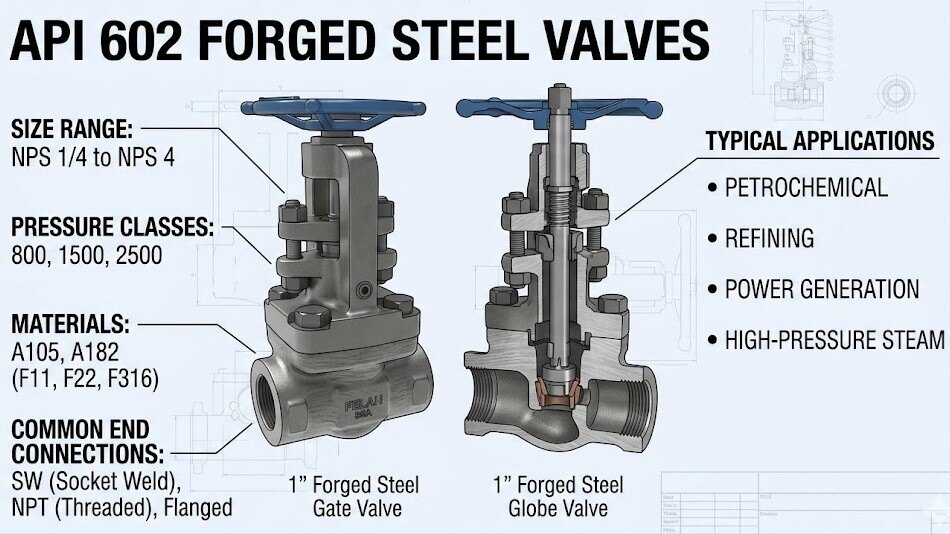
API 602 is an industrial standard developed by the American Petroleum Institute (API), specifically for the design, manufacturing, and testing requirements of small-diameter forged steel valves. It applies primarily to valves with a size of NPS 4 and below (DN100 and below), covering gate valves, globe valves, check valves, ball valves, and plug valves.
The full title of API 602 is “Compact Steel Gate Valves—Flanged, Threaded, Socket-Welding, and Extended Body”. It defines the minimum technical requirements for small forged steel valves used in refinery and related industrial piping systems. All valves complying with API 602 must also meet the requirements of ASME B16.34 regarding pressure-temperature ratings and structural dimensions. This ensures interchangeability of products within the global supply chain.
For procurement engineers, project managers, and equipment engineers, API 602 is one of the most frequently referenced standards in high-pressure and high-temperature piping system valve selection. A deep understanding of its technical requirements helps avoid selection errors, procurement delays, and premature valve failure.
Having understood the basic concept and importance of API 602, we now examine the types of valves covered by this standard and their respective functions and applications.
Globe valves are known for their excellent throttling and flow regulation capabilities. Their working principle is based on the vertical movement of a disc to control fluid flow inside the valve, enabling precise flow regulation. This design makes them highly suitable for applications requiring accurate flow control.
In chemical production processes where strict control of medium flow is required, API 602 forged globe valves are often the preferred choice. These valves are manufactured strictly according to API 602 requirements, using high-quality materials and rigorous production processes. They offer strong pressure and temperature resistance and can adapt to various industrial environments.
A check valve functions like a “one-way channel,” allowing fluid to flow in only one direction while preventing backflow. This function is critical in many systems because reverse flow may cause equipment damage or process disruption.
For example, in water supply systems, backflow may lead to contamination of clean water sources. API 602 forged check valves are made from high-strength forged materials, capable of withstanding flow impact and ensuring long-term stable operation. The API 602 standard ensures excellent sealing performance and reliability, making them suitable for continuous service conditions.
Gate valves are primarily used for on/off service, achieving fluid opening and closure through the lifting and lowering of a gate. When fully open, they offer minimal flow resistance, making them ideal for systems requiring large flow capacity.
In oil and gas pipelines, gate valves are commonly used for flow isolation and control. API 602 forged gate valves feature a robust structure capable of withstanding high pressure and high temperature. Their design and manufacturing fully comply with API 602 standards, ensuring reliability and safety.
In addition to the main types above, API 602 forged valves also include several other categories:
- Forged Ball Valve: Flow is controlled by rotating a ball with a bore. When the bore aligns with the pipeline, the valve is open; when rotated 90 degrees, it is closed. Ball valves offer fast operation and excellent sealing performance.
- Forged Plug Valve: Flow is controlled by a tapered or cylindrical plug. It has a simple structure and is suitable for applications requiring reliable shutoff.
- Forged Butterfly Valve: Flow regulation is achieved by rotating a disc. It features compact structure, lightweight design, and small footprint, making it suitable for space-constrained installations.
Pressure class is one of the most critical parameters in API 602 valve selection. Different pressure classes define the maximum allowable working pressure (MAWP) at a given temperature. The main pressure classes include:
- Class 800 LB: This is the most widely used pressure class. At 38°C (100°F), Class 800 has a maximum allowable working pressure of approximately 138 bar (2000 psi). It is suitable for most refinery auxiliary systems and instrument lines.
- Class 1500 LB: Under the same temperature conditions, Class 1500 provides a maximum allowable working pressure of approximately 260 bar (3750 psi). It is used in higher-pressure applications.
- Class 2500 LB: This class offers a maximum allowable working pressure of approximately 430 bar (6250 psi) and is mainly used in high-pressure steam systems and gas injection services.
- Class 4500 LB: This is the highest pressure class under API 602, with a maximum allowable working pressure of approximately 770 bar (11250 psi). It is used in extreme high-pressure applications.
Using ASTM A105N carbon steel as an example, the pressure capacity increases significantly with each class at 38°C (100°F). When selecting a pressure class, it is essential to ensure that the valve can safely operate within actual service conditions; otherwise, valve failure or system malfunction may occur.
API 602 supports a wide range of forged materials to meet different service conditions:
- ASTM A105N Carbon Steel: The most commonly used body material, suitable for general oil, gas, steam, and water systems. It offers good mechanical properties and cost efficiency, making it the preferred choice for most standard applications.
- ASTM A182 F316/F316L Stainless Steel: Suitable for corrosive media and low-temperature environments. With molybdenum addition, it provides superior corrosion resistance compared to 304 stainless steel, especially in chloride environments.
- ASTM A182 F11 and F22 Chromium-Molybdenum Alloy Steel: Designed for high-temperature steam and refinery applications. These materials offer excellent high-temperature strength and creep resistance for long-term operation under harsh conditions.
- ASTM A182 F51/F53 Duplex Stainless Steel: Suitable for highly corrosive environments such as hydrogen sulfide or seawater. Duplex stainless steel combines the advantages of austenitic and ferritic stainless steels, offering high strength and excellent resistance to stress corrosion cracking.
Valve trim is a key component affecting valve lifespan and corrosion resistance, including the stem, seat, and disc. API 602 defines standardized trim numbers for different material combinations:
- Trim 8: Uses 410 stainless steel, suitable for general service conditions. It is a martensitic stainless steel with good strength and moderate corrosion resistance.
- Trim 5 and Trim 16: Use Stellite hardfacing materials to enhance erosion resistance. Stellite alloys offer extremely high hardness and wear resistance, suitable for fluids containing solid particles or high flow velocity.
- Trim 12: Specifically used for 316 stainless steel corrosive environments, providing excellent corrosion resistance.
For sour service (acidic environments containing hydrogen sulfide), trim materials must comply with NACE MR0175 / ISO 15156 standards to ensure material hardness and resistance to sulfide stress cracking. This is a mandatory safety requirement in oil and gas production systems.
API 602 valves are available with multiple end connection types to suit different installation requirements:
- Socket Weld (SW): Suitable for small-diameter high-pressure pipelines. It offers high strength and sealing performance with relatively easy installation.
- Butt Weld (BW): Used in high-temperature, high-pressure, and critical service conditions. It provides the highest strength and reliability.
- Threaded (NPT/BSP): Commonly used in instrumentation or low-risk systems. It is easy to install and maintain but has lower pressure capacity.
- Flanged (RF/RTJ): Suitable for applications requiring frequent disassembly or high sealing requirements. It offers convenience for maintenance but requires more space and higher cost.
When selecting an appropriate API 602 forged valve, the following key factors must be considered:
- Type of Medium: Different fluids have different corrosivity, viscosity, and temperature characteristics. Highly corrosive media require corrosion-resistant materials such as stainless steel, while media containing solid particles require wear-resistant designs.
- System Pressure and Temperature: The selected valve must safely operate within actual working conditions, including normal pressure, pressure fluctuations, and temperature extremes.
- Flow Control Requirements: For large flow and fast operation, gate or ball valves are preferred. For precise regulation, globe valves are more suitable. For backflow prevention, check valves are required.
- Installation Space Constraints: In limited spaces, compact valves such as butterfly valves may be more appropriate.
- Maintenance Requirements: The need for frequent maintenance affects the choice of end connection type.
API 602 forged valves are widely used in the following industries:
- Oil and Gas Production and Transportation: Used in wellhead facilities, gathering pipelines, and processing stations for flow control of various process media.
- Refining Industry: Extensively used in atmospheric and vacuum distillation units, catalytic cracking units, and hydroprocessing units.
- Petrochemical and Chemical Production: Applied in reactors, heat exchangers, and separation systems.
- Power Generation Steam Systems: Used in thermal and nuclear power plant steam and feedwater systems requiring high-temperature and high-pressure resistance.
- LNG Cryogenic Systems: Applied in liquefaction, storage, and transportation systems.
- Fire Protection Systems: Used in high-pressure water and foam fire suppression systems.
API 602 is not only a technical standard but also a core specification for small-diameter forged steel valves in global industrial applications. It covers a wide range of valve types, including globe, check, gate, ball, plug, and butterfly valves, each with distinct functions and applications.
A correct understanding of API 602 pressure classes, material specifications, and structural requirements is essential for ensuring system safety, reducing maintenance costs, and extending equipment service life. In the selection process, engineers must comprehensively consider media characteristics, operating conditions, and control requirements to choose the most suitable valve.
By fully understanding different valve characteristics and aligning them with real-world applications, engineers can make more informed decisions, improving overall system performance and safety. Whether for new projects or system upgrades, a solid grasp of API 602 provides significant engineering value.
