Complete Guide to Double Flanged Butterfly Valves
In modern industrial production and urban infrastructure development, pipeline systems play a crucial role in transporting water, oil, gas, and various chemical media. Whether in municipal water supply networks, power plant cooling systems, or chemical processing facilities, reliable valves are essential for controlling fluid flow. Among many types of valves, the double flanged butterfly valve has become an indispensable control device in large-diameter pipeline systems due to its robust structure, easy operation, and wide applicability.
For engineering projects involving pipelines above DN400 and pressure ratings of PN16 and above, selecting an appropriate valve directly affects system safety, operational stability, and long-term maintenance costs. This article provides a comprehensive introduction to double flanged butterfly valves from multiple perspectives, including basic structure, technical parameters, installation and maintenance, application fields, and selection guidelines, helping engineers and procurement personnel fully understand this critical equipment.
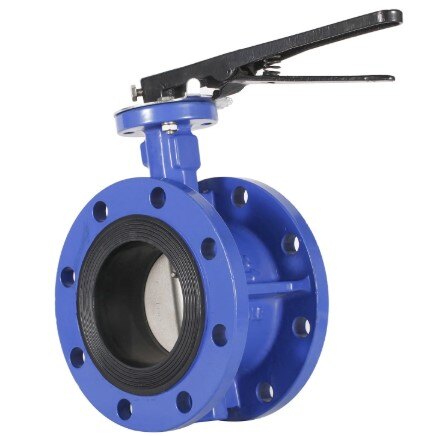
A double flanged butterfly valve is a mechanical device used to regulate fluid flow in pipelines. Its name comes from its structural design: both ends of the valve body are equipped with flanges, which can be directly connected to pipeline flanges to form a rigid and stable connection.
The core working element of the butterfly valve is a circular disc mounted on a central shaft. When the disc rotates 90 degrees (a quarter turn), the valve transitions from fully closed to fully open. This simple rotary motion makes operation extremely straightforward without requiring complex mechanical structures.
In industrial pipelines, the most common butterfly valve types include double flanged butterfly valves, wafer type butterfly valves, and lug type butterfly valves. Understanding their differences helps in selecting the correct solution.
- Double Flanged vs. Wafer Type Butterfly Valves: Wafer type butterfly valves are installed between two pipeline flanges and do not have their own flanged body. They rely on the clamping force of the pipeline flanges for positioning. In contrast, double flanged butterfly valves have integral flanges at both ends, directly bolted to pipeline flanges. This design gives double flanged butterfly valves significantly higher structural stability, making them especially suitable for large-diameter and high-pressure systems.
- Double Flanged vs. Lug Type Butterfly Valves: Lug type butterfly valves have threaded lugs on both sides of the valve body, allowing direct bolting to pipeline flanges. Their key advantage is easier installation and removal, especially in systems where one side of the pipeline may need to be disconnected without disturbing the other. However, lug type valves are generally limited to pressure ratings of PN10 to PN16 and are mainly used in low to medium pressure applications.
By contrast, double flanged butterfly valves provide rigid flange-to-flange connections with design pressures up to PN16–PN40 or even higher. They offer more uniform sealing performance and are suitable for high-pressure, high-temperature, or corrosive media in long-distance pipeline systems.
A double flanged butterfly valve consists of the following key parts:
- Valve Body: Typically made of ductile iron (GGG40/50), cast iron, or carbon steel. To enhance corrosion resistance, the body is usually coated with epoxy resin. Both ends are equipped with integral flanges with bolt holes aligned to pipeline flanges.
- Valve Disc (Butterfly Plate): The key flow control element, usually made of stainless steel 304, stainless steel 316, or aluminum bronze. Material selection depends on medium corrosiveness and operating temperature.
- Seat / Sealing Ring: Depending on the medium, materials include EPDM, NBR, Viton, or PTFE. The seat is installed on the valve body or disc to achieve sealing performance.
- Valve Shaft: Made of high-strength stainless steel, connecting the disc to external actuators. It must withstand pressure loads and operating torque.
- Actuator Mounting Flange: Designed according to ISO 5211 standard, allowing installation of handwheels, gearboxes, electric actuators, or pneumatic actuators for manual or automated control.
After understanding the basic concept, it is important to examine the technical parameters that determine whether the valve is suitable for specific operating conditions.
The nominal diameter (DN) typically ranges from DN40 to DN1200. For large infrastructure projects such as municipal water systems, manufacturers can produce valves exceeding DN2000. The size selection depends primarily on required flow rate and velocity design.
Common pressure classes include PN6, PN10, and PN16.
Generally:
Small diameter valves (below DN300) often use PN16
Large diameter valves (above DN300) typically use PN10
This difference is mainly due to weight and cost optimization. If large valves are designed for higher pressure classes, body thickness increases significantly, resulting in excessive weight, higher manufacturing cost, and difficulties in transportation and installation.
For special high-pressure applications, double flanged butterfly valves can be designed for PN40 or even higher, meeting the stringent requirements of petrochemical and power industries.
Temperature resistance depends mainly on seat material:
EPDM: -30°C to 110°C, good aging resistance, suitable for water applications
NBR: good oil resistance, similar temperature range as EPDM
Viton: excellent high-temperature resistance up to 200°C, suitable for steam and chemical media
PTFE: outstanding chemical stability and temperature resistance, but lower elasticity requiring special design considerations
Face-to-face length refers to the distance between sealing faces of both flanges, which is a critical installation dimension.
Common standards include:
EN 558-1 Series 13
JIS F7480
Compliance with international standards allows easy replacement without modifying pipeline layout, significantly reducing maintenance costs.
Material selection depends on pressure, temperature, and medium characteristics.
- Corrosive Media: For acids, alkalis, and salt solutions, stainless steel 316 body with PTFE seat is recommended. The molybdenum content in 316 improves resistance to pitting and crevice corrosion compared to 304.
- Seawater Applications: Due to high chloride content, aluminum bronze discs with NBR seats are commonly used. Aluminum bronze provides excellent seawater corrosion resistance.
- Potable Water Systems: Ductile iron bodies with epoxy coating, stainless steel 304 discs, and EPDM seats are commonly used, meeting drinking water safety standards.
- High-Temperature Steam: Above 150°C, rubber seats degrade rapidly. Metal-seated designs or Viton seals with carbon steel or stainless steel bodies are required.
Proper installation and maintenance are essential for long-term stable operation.
Before installation, the following checks are required:
Verify specifications: DN size, pressure class, face-to-face length, flange standard (PN16/ANSI 150LB), and material configuration
Check bolt circle diameter (BCD) compatibility between valve and pipeline flanges
Inspect valve for transport damage, disc rotation flexibility, and sealing surface defects
Prepare bolts, nuts, gaskets, and torque wrenches matching flange requirements
The installation process is relatively straightforward:
- Position the valve between two pipeline flanges and align bolt holes
- Insert bolts through one flange, the valve body, and the opposite flange
- Tighten nuts lightly using a diagonal cross pattern
- Final tightening using a torque wrench to ensure uniform sealing pressure
- Install actuator (handwheel, gearbox, electric or pneumatic actuator) on ISO 5211 mounting flange
The cross-tightening method ensures even gasket compression and prevents leakage due to uneven stress distribution.
Although designed for low maintenance, periodic inspection is still necessary:
- Inspect sealing performance every 6–12 months
- Check for leakage at the stem packing and tighten if necessary
- Replace packing if leakage becomes severe
- Replace seat if leakage occurs in closed position
- Maintain actuators according to manufacturer instructions
Because both flanges must be loosened for disassembly, maintenance time is longer compared to lug type valves. Therefore, double flanged butterfly valves are more suitable for long-term continuous operation systems with minimal maintenance requirements.
- Water Treatment Industry: Widely used in drinking water plants, wastewater treatment plants, and municipal circulation systems. EPDM seats ensure safety and chlorine resistance. Large diameters (DN400–DN1200) are common in municipal networks with PN10/PN16 ratings.
- Marine and Offshore Engineering: Used in seawater cooling, ballast water, and fire protection systems. Corrosion-resistant materials such as epoxy-coated ductile iron bodies, aluminum bronze discs, and NBR seats are commonly used.
- Power Industry: Applied in cooling water, circulation systems, and auxiliary steam systems in thermal and nuclear power plants. Large sizes are often equipped with gearboxes or electric actuators. High-temperature applications require Viton or metal-seated designs.
- Chemical and Oil Industry: Used for corrosive and flammable media such as acids, solvents, and petroleum products. Stainless steel 316 with PTFE seats is common for corrosive applications, while NBR is used for oil systems.
- Mining and Metallurgy Industry: Used in slurry, tailings, and cooling water systems. Wear-resistant linings or rubber-coated designs help reduce abrasion and prevent clogging.
- Structural Stability: The integral flange design provides self-supporting structure, allowing the valve to withstand pipeline stress without additional supports. This is particularly important in large-diameter pipelines where valve weight can reach several tons.
- High Pressure Capability: Rigid flange connections allow higher pressure ratings compared to lug or wafer types, making them suitable for petrochemical and power applications.
- Reliable Sealing: Uniform compression of sealing surfaces ensures stable sealing performance under both low and high pressure conditions.
- Simple and Fast Operation: A 90-degree rotation enables quick opening and closing, especially when combined with automated actuators for emergency shutdown systems.
- Compact Structure and Lightweight Design: Compared with gate and globe valves, butterfly valves are shorter and lighter, reducing installation space requirements and transportation costs.
- Low Maintenance Cost: Simple structure with fewer moving parts reduces failure rates. Seat replacement is relatively easy and can often be performed onsite without full valve removal.
Double flanged butterfly valves are widely used in chemical, water treatment, heating, air conditioning, petroleum, and power industries due to their simple structure, lightweight design, fast operation, excellent sealing performance, and long service life.
They are suitable for a wide range of applications, from small municipal systems to large refinery pipelines. In large-diameter systems, their self-supporting structure, high pressure resistance, and reliable sealing make them a preferred choice.
Although initial cost may be higher than wafer or lug type valves, their overall economic performance is superior in high-pressure, large-diameter, and long-term operating conditions.
With increasing industrial automation, double flanged butterfly valves equipped with electric or pneumatic actuators are becoming more widely used in remote control systems. In the future, intelligent valve technologies with sensors and diagnostic functions will further enhance their value in Industry 4.0 environments. For engineers and procurement specialists, a clear understanding of their structure, parameters, and applications is essential for selecting the right solution and ensuring safe, efficient, and economical pipeline operation.
