Complete Guide to Pneumatic Ball Valve Selection
Pneumatic ball valves are among the most widely used valve types in modern industrial automation control systems. Simply put, a pneumatic ball valve is a switching device driven by compressed air. The pneumatic actuator rotates the ball by 90 degrees to achieve pipeline opening or closing and can also be used for flow regulation. Compared with manual valves, pneumatic ball valves are highly automated, support remote control, and respond quickly. Compared with electric valves, they are safer in flammable and explosive environments because they do not require electrical power and do not generate sparks.
Pneumatic ball valve selection is a systematic engineering task that requires simultaneous consideration of three components: the valve body, the cylinder actuator, and auxiliary accessories. Improper selection of any single component may cause the valve to malfunction.
Minor issues may only affect service life, while serious mistakes can prevent the valve from meeting process requirements and may even trigger production accidents. Therefore, before selection, it is necessary to thoroughly understand process parameters such as medium properties, temperature, pressure, and flow requirements, as well as the operating environment, including explosion-proof requirements and air supply conditions.
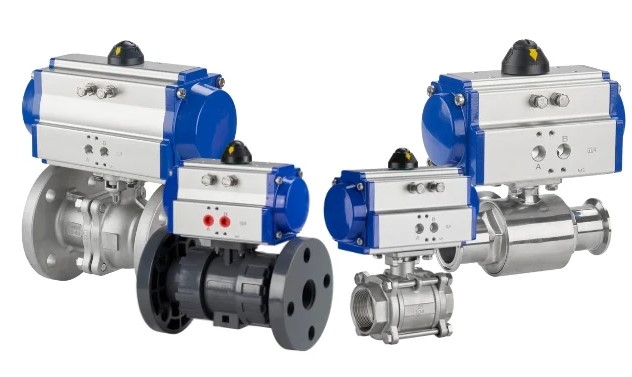
After understanding the overall structure and importance of pneumatic ball valve selection, the core component, the valve body, must be discussed first. The valve body is the part directly in contact with the controlled medium, and its design determines whether the valve can adapt to operating conditions.
The connection method between the valve and pipeline directly affects installation convenience and sealing reliability:
- Flanged connection: The most common connection type, suitable for various diameters. It is easy to install and dismantle, provides reliable sealing performance, and is the preferred choice for industrial pipeline systems.
- Wafer connection: Features compact structure, lightweight design, and space-saving advantages. It is suitable for installations where space is limited.
- Threaded connection (internal thread) : Mainly used for small-diameter pipelines (usually below DN50). Installation is simple and convenient.
- External threaded connection: Less commonly used and generally applied in special conditions.
- Quick-assembly connection: Primarily used in industries such as food and pharmaceuticals where hygienic requirements are strict. It allows fast disassembly and cleaning.
- Welded connection: Including butt welding and socket welding, providing the best sealing performance. It is suitable for high-pressure, high-temperature, or leakage-restricted applications.
The sealing structure determines the applicable working conditions of the valve.
- Metal hard-seal ball valve: Both the seat and the ball are made of metal materials. This structure can withstand high temperatures (over 500°C) and is highly wear-resistant, making it suitable for media containing solid particles such as coal ash or slurry. However, sealing performance is relatively weaker, and achieving zero leakage is difficult.
- Soft-seal ball valve: The valve seat is made of elastic materials such as polytetrafluoroethylene (PTFE) or polyphenylene (PPL). These valves provide excellent sealing performance and can achieve zero leakage, making them suitable for clean gases and liquids. However, temperature resistance is limited, generally not exceeding 200°C, and they are not suitable for media containing solid particles.
Valve body material should be selected based on medium characteristics and operating temperature:
- Carbon steel: The most commonly used material, suitable for water, steam, and oil media. The temperature range is approximately -29°C to 425°C.
- Low-temperature steel: Suitable for cryogenic conditions below -100°C, such as liquefied natural gas (LNG) systems.
- Stainless steel 304/304L: Suitable for mildly corrosive media, commonly used in food and chemical industries.
- Stainless steel 316/316L: Offers better corrosion resistance and is suitable for seawater, acid-base media, and other corrosive environments.
- Duplex stainless steel: High strength and resistant to chloride stress corrosion, suitable for offshore platforms and seawater desalination systems.
- Titanium alloy: Highly resistant to strong corrosion but expensive, usually used in special applications.
Select the appropriate valve type according to operating temperature:
- Normal temperature ball valve: -40°C to 120°C, suitable for general working conditions
- Medium-temperature ball valve: 120°C to 450°C, suitable for steam and hot oil systems
- High-temperature ball valve: ≥450°C, requires special design and materials
- Low-temperature ball valve: -100°C to -40°C, used in refrigeration systems
- Ultra-low-temperature ball valve: ≤-100°C, used for deep cryogenic gas systems
- Low-pressure ball valve: PN ≤ 1.6MPa, suitable for general water and gas pipelines
- Medium-pressure ball valve: 2.0–6.4MPa, suitable for industrial pipeline systems
- High-pressure ball valve: ≥10MPa, used in high-pressure hydraulic systems and hydrogenation units
- Vacuum ball valve: Below atmospheric pressure, used in vacuum systems
- Floating ball valve: The ball can float slightly and is pressed against the seat by medium pressure to achieve sealing. It is suitable for medium and low-pressure, small-diameter applications.
- Fixed ball valve: The ball is fixed while the seat is floating. It is suitable for high-pressure and large-diameter applications.
- V-notch ball valve: The ball contains a V-shaped notch and provides regulating function with a large turn-down ratio. It is suitable for flow control applications.
- Eccentric half-ball valve: Offers excellent sealing performance and low operating torque, suitable for media containing solid particles.
- Rotary ball valve: A special structure used for high differential pressure conditions.
- Two-way straight-through ball valve: The most common structure, used for simple switching control.
- Three-way ball valve: Includes L-type and T-type flow passages, allowing medium diversion or merging.
- Four-way ball valve: Used for more complex flow direction switching.
After selecting the valve body, many users become confused about actuator selection: What is the difference between single-acting and double-acting types? Which cylinder type is more suitable for specific operating conditions? How much output torque is required? This chapter answers these key questions.
- Double-acting piston pneumatic actuator: This is the most common type and consists of a cylinder body, end covers, piston, gear shaft, limit blocks, adjustment screws, and position indicator. Compressed air serves as the driving force to push piston movement. The rack-and-pinion mechanism converts piston linear motion into 90-degree rotation of the valve shaft. Double-acting actuators require two air ports that alternately intake and exhaust air to achieve forward and reverse rotation. Their advantages include high torque output, fast response speed, and simple and reliable structure.
- Single-acting piston pneumatic actuator: Based on the double-acting type, return springs are added. When air supply fails, the spring force returns the valve to a safe position. This design improves system safety and prevents accidents caused by air supply interruption. When selecting a single-acting actuator, it is necessary to clearly define whether the safe position is normally open or normally closed. Normally closed (air-to-open type): The valve closes when there is no air supply and opens when air is supplied. Normally open (air-to-close type): The valve opens when there is no air supply and closes when air is supplied.
Three main cylinder types are widely used in the market:
- GT Cylinder: An earlier classical model with a simple structure. However, installation accessories require brackets, making installation relatively inconvenient.
- AT Cylinder: An improved version of GT cylinder and currently the mainstream product. The biggest advantage is bracket-free installation with ball valves, making installation faster and more secure. The 0° and 90° positions can be adjusted easily, facilitating the installation of solenoid valves, limit switches, and handwheel mechanisms.
- AW Cylinder: Mainly used for large-diameter ball valves. It adopts a piston fork structure, provides large torque output, and is suitable for high differential pressure conditions.
In practical engineering applications, purely mechanical pneumatic ball valves often cannot meet complex control requirements. Remote switching, opening regulation, fault position retention, and signal feedback all require various pneumatic accessories.
Installed between the ball valve and actuator, it allows manual operation during air supply failure or debugging, ensuring system safety and production continuity. It is strongly recommended for critical operating conditions.
These include a filter-regulator unit (FR unit) and a filter-regulator-lubricator unit (FRL unit).
Their function is to filter moisture and impurities in compressed air, regulate pressure to an appropriate level, and lubricate the cylinder. Installation is strongly recommended because it prevents cylinder jamming caused by contaminants and significantly extends service life.
The solenoid valve controls the opening and closing of the air circuit and is a key component of pneumatic systems:
Double-acting cylinder: equipped with a 2-position 5-way solenoid valve or 3-position 5-way solenoid valve (the latter provides a mid-position holding function).
Single-acting cylinder: equipped with a 2-position 3-way solenoid valve.
Voltage options include DC24V and AC220V, depending on the control system. Explosion-proof solenoid valves must be used in flammable and explosive environments.
The limit switch converts mechanical rotation into electrical signals and feeds back valve position to the control system. Common types include mechanical and magnetic induction switches. Explosion-proof types are required for hazardous environments.
Used for proportional control pneumatic ball valves such as V-notch ball valves. It receives 4–20mA control signals to precisely regulate valve opening.
Positioners are divided into standard and intelligent types. Intelligent positioners provide auto-tuning and self-diagnostic functions.
Whether feedback output signals are required for monitoring and whether explosion-proof design is necessary must be considered.
Installed between the cylinder and solenoid valve, the quick exhaust valve allows air to be discharged directly without passing through the solenoid valve, thereby accelerating valve closing speed. It is suitable for rapid shutoff applications.
The pneumatic amplifier receives pressure signals from the positioner and supplies large airflow to the actuator, improving valve response speed.
It transmits signals in a 1:1 ratio and is mainly used for long-distance signal transmission (0–300 meters) to reduce signal delay.
The locking valve monitors air supply pressure. When pressure drops below the set value, it cuts off the valve air supply line, keeping the valve in its pre-failure position. When air supply is restored, normal operation resumes.
The selection methods described above are suitable for most conventional working conditions. However, in special fields such as food and pharmaceuticals, high temperature and high pressure, or cryogenic environments, additional technical requirements and industry standards must be considered.
In food, beverage, and pharmaceutical industries, in addition to conventional medium temperature and pressure considerations, the following must be noted:
Food-grade materials must be used, usually stainless steel 304 or 316L.
High surface finish is required to facilitate cleaning.
Quick-assembly connections are preferred for easy disassembly and sterilization.
Sealing materials must meet food-grade standards.
Metal hard-seal structures must be used.
Actuator torque should be increased because friction resistance increases under high temperature.
Heat dissipation measures should be considered to prevent thermal conduction from damaging actuator seals.
Low-temperature steel materials should be used.
A long-neck valve bonnet design should be adopted to keep the packing gland away from the low-temperature zone.
The effect of thermal contraction on sealing performance must be considered.
Metal hard seals with good wear resistance should be selected.
Eccentric half-ball valves or V-notch ball valves should be used because they provide a shearing function.
Regular maintenance should be performed to remove deposits.
- Define process parameters: medium properties, temperature, pressure, flow rate, and pipe diameter.
- Determine valve type: select switching or regulating type based on functional requirements.
- Choose connection method and material based on pipeline standards and medium characteristics.
- Determine sealing structure according to leakage requirements and medium cleanliness.
- Select actuator type: single-acting or double-acting according to air supply and safety requirements.
Calculate output torque to ensure actuator torque exceeds maximum valve operating torque.
Configure necessary accessories according to control requirements and safety standards.
Consider special requirements such as explosion-proof, corrosion resistance, and food-grade standards.
Ignoring safety position requirements: The safe position of single-acting actuators must be clearly defined (normally open or normally closed). Incorrect selection may cause accidents.
Insufficient torque calculation: Failure to consider high differential pressure or increased friction after long-term operation may cause incomplete valve closure.
Ignoring air supply quality: Failure to install air treatment components may lead to premature cylinder damage.
Improper material selection: Using ordinary carbon steel for corrosive media may lead to rapid damage.
Incorrect sealing structure: Selecting soft seals for particulate media will cause rapid wear and leakage.
Pneumatic ball valve selection is a technical task that requires comprehensive consideration of multiple factors. Only by fully understanding process requirements and the characteristics of various products can the most suitable valve configuration be selected.
For important projects, it is recommended to consult professional manufacturers and provide detailed operating parameters to obtain professional selection advice, ensuring long-term and stable system operation.
By following the guidance in this article, you can gain a comprehensive understanding of pneumatic ball valve selection. In practical applications, it is advisable to establish a selection checklist and verify parameters one by one to avoid missing critical details and thus choose a reliable and economically reasonable pneumatic ball valve.
