How to Select Electric Actuators for Industrial Valves
In modern industrial automation control systems, electric valve actuators play a vital role. They are essential driving devices for achieving programmatic, automatic, and remote control of valves by controlling stroke, torque, or axial thrust to accomplish precise valve operation. This article provides a detailed introduction to the working principle, structural composition, classification methods, and key selection considerations of electric valve actuators, helping engineering and technical personnel better understand and apply this critical equipment.
Electric valve actuators are typically composed of six core components, each performing a specific function.
The special electric motor serves as the power source and has significant differences compared with conventional motors. It features strong overload capacity, high starting torque, and low rotational inertia, and is specifically designed for short-time and intermittent operating modes. This special design ensures stable motor performance under frequent start-stop conditions.
The reduction mechanism is responsible for lowering the motor output speed by converting high-speed, low-torque motor output into low-speed, high-torque actuator output to meet the force and speed requirements of valve operation.
The stroke control mechanism is used to regulate and accurately control the opening and closing positions of the valve, ensuring the valve reaches the fully open or fully closed position and enabling precise positioning at intermediate positions.
The torque limiting mechanism is a key safety protection component used to regulate torque or thrust so that it does not exceed the preset value, thereby preventing damage to the valve or the actuator caused by overload conditions.
The manual/electric switching mechanism provides interlocking functionality for manual or electric operation. In the event of power failure or emergency situations, the system can be switched to manual mode to ensure operational reliability and safety.
The opening indicator displays the valve position in real time during the opening and closing process, providing operators with intuitive status feedback.
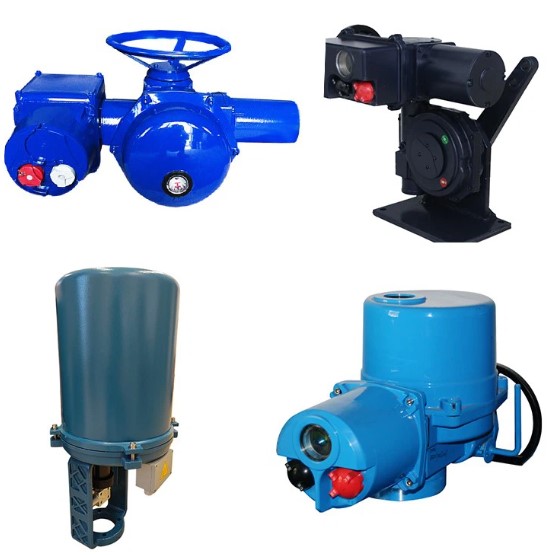
According to the motion characteristics of the output shaft, electric valve actuators are mainly divided into three categories, each suitable for different types of valves.
Part-turn actuators rotate less than one full revolution of the output shaft, usually requiring about 90° rotation to complete valve opening and closing control. These actuators are mainly used for butterfly valves, ball valves, plug valves, and other rotary valves.
According to different mounting interface methods, part-turn actuators can be further divided into two forms.
Direct-connection type refers to the installation method in which the actuator output shaft is directly connected to the valve stem. This structure is simple and offers high transmission efficiency, making it suitable for applications with sufficient installation space and coaxial alignment between the valve stem and actuator.
Base crank type refers to the connection between the output shaft and the valve stem through a crank mechanism. This design can accommodate different installation angles and positions and is advantageous in situations with limited space or when transmission direction needs to be changed.
Multi-turn actuators have an output shaft rotation exceeding one full revolution and usually require multiple rotations to achieve complete valve opening or closing. These actuators are mainly used for gate valves, globe valves, and other valves that require multi-turn operation.
For multi-turn rising-stem valves, special attention must be paid to stem diameter matching during selection. The inner diameter of the hollow output shaft of the electric actuator must be larger than the outer diameter of the rising valve stem; otherwise, assembly cannot be completed. For some part-turn valves and non-rising stem valves in the multi-turn category, although stem diameter clearance is not required, the matching between stem diameter and keyway dimensions must still be carefully considered to ensure proper operation after assembly.
Linear stroke actuators perform linear motion rather than rotational motion and are mainly used for control valves requiring linear displacement regulation, such as single-seat and double-seat control valves.
According to different control functions, electric valve actuators can be divided into on-off type and regulating type, each with different structural forms.
On-off actuators are used for simple opening and closing control of valves. The valve operates only in fully open or fully closed positions and does not require precise flow regulation.
According to structural configuration, on-off actuators are divided into split-type and integrated-type structures. The selection must be clearly specified; otherwise, installation mismatch with the control system may occur.
The split structure (standard type) separates the control unit from the actuator. The actuator alone cannot control the valve and must be equipped with an external control unit, usually in the form of a controller or control cabinet.
The disadvantages of this structure include inconvenient system integration, increased wiring and installation costs, difficulty in fault diagnosis and maintenance, and relatively low cost-effectiveness.
The integrated structure combines the control unit and actuator into a single sealed unit, enabling local operation without external control units. Remote operation only requires transmission of control signals.
The advantages of this structure include easier system installation, reduced wiring and installation costs, and simplified fault diagnosis and troubleshooting. However, traditional integrated products still have certain limitations, which has led to the development of intelligent electric actuators.
Regulating actuators not only provide the basic functions of on-off integrated structures but also enable precise valve control and continuous flow regulation.
These actuators usually receive control signals such as current signals (4–20mA, 0–10mA) or voltage signals (0–5V, 1–5V). Therefore, the type and parameters of control signals must be clearly defined during selection.
Regulating actuators operate in two modes:
- Electric-opening type: Taking the 4–20mA signal as an example, a 4mA signal corresponds to valve closure while 20mA corresponds to full opening. As the signal current increases, the valve opening gradually increases.
- Electric-closing type: Using the 4–20mA signal as an example, 4mA corresponds to full opening while 20mA corresponds to valve closure. As the signal current increases, the valve opening gradually decreases.
Signal loss protection is an important safety function of regulating actuators. When control signals are lost due to line failure, the actuator will move the valve to a preset protection position. Common protection positions include full open, full close, or hold position, which should be determined according to process safety requirements.
Proper selection of electric valve actuators requires comprehensive consideration of multiple technical parameters.
Operating torque is the most important parameter when selecting an electric valve actuator. The actuator output torque should be 1.2–1.5 times the maximum operating torque of the valve. This safety factor ensures sufficient driving force while preventing damage to the valve due to excessive torque.
The torque required for valve operation is determined by factors such as valve diameter and working pressure. It should be noted that valves of the same specification but produced by different manufacturers may require different operating torques. Even products from the same manufacturer with identical specifications may also exhibit torque variation. If the actuator torque is too small, the valve cannot be opened or closed properly; if it is too large, the internal structure of the valve may be damaged.
The main body structure of electric valve actuators has two forms.
The thrust-disc-free structure directly outputs torque and is suitable for applications requiring rotational torque only.
The structure equipped with a thrust disc converts output torque into axial thrust through a stem nut inside the thrust disc, making it suitable for applications requiring axial thrust, such as gate valves.
For multi-turn valves, the total number of rotations required by the actuator must be calculated using the following formula:
M = H / (Z × S)
Where M represents the total number of actuator rotations, H is the valve opening height, S is the stem thread pitch, and Z is the number of thread starts on the stem.
For multi-turn rising-stem valves, it is necessary to ensure that the maximum stem diameter allowed by the actuator is larger than the valve stem outer diameter. For part-turn valves and non-rising stem valves, although stem clearance is not required, proper matching between stem diameter and keyway dimensions must still be ensured.
If the valve opening and closing speed is too high, water hammer may occur, potentially causing damage to the pipeline system. Therefore, appropriate operating speed should be selected according to specific service conditions such as medium characteristics, pipeline length, and pressure rating.
According to operating environment and explosion-proof requirements, electric valve actuators can be classified into several types.
The standard type is suitable for indoor or non-special environmental conditions.
The outdoor type is equipped with dustproof, waterproof, and corrosion-resistant protection and is suitable for outdoor installation environments.
Explosion-proof type complies with explosion-proof standards and is suitable for hazardous locations containing explosive gases.
Outdoor explosion-proof type combines outdoor protection and explosion-proof functions and is suitable for outdoor hazardous environments.
During selection, factors such as temperature, humidity, corrosion conditions, and explosion-proof requirements of the installation environment should be considered.
Electric valve actuators must be capable of limiting torque or axial force, usually achieved by using torque-limiting couplings. Once the actuator specification is determined, its control torque is also fixed.
Under normal conditions, the motor will not be overloaded when operating within a predetermined time. However, overload may occur under the following conditions:
- Low supply voltage preventing the motor from generating required torque
- Incorrect torque limit setting where the preset value exceeds the stopping torque
- Heat accumulation caused by intermittent operation exceeding allowable temperature rise
- Circuit failure of the torque limiting mechanism
- Reduced motor thermal capacity due to excessively high ambient temperature
Traditional motor protection methods include fuses, overcurrent relays, thermal relays, and thermostats, each having advantages and disadvantages. For electric actuators, which are variable-load devices, there is no absolutely reliable single protection method. Therefore, combined protection strategies must be adopted:
- Monitor changes in motor input current
- Monitor the heating condition of the motor itself
In practical applications, thermostats are used for overload protection under continuous or jog operation conditions; thermal relays are used for motor stall protection; and fuses or overcurrent relays are used for short-circuit protection. Regardless of the protection method used, the motor thermal capacity and allowable time margin must be considered.
Based on the above content, the standard selection process for electric valve actuators should include the following steps:
First, determine the valve type. Clarify whether the matching valve is a butterfly valve, ball valve, gate valve, globe valve, or control valve to determine the required actuator motion mode (part-turn, multi-turn, or linear stroke).
Second, determine the control requirements. Specify whether simple on-off control or precise regulating control is required and determine the type of control signal, such as switching signal, 4–20mA, or 0–10V.
Third, calculate key parameters, including valve operating torque, opening height, stem diameter, and required rotation count, to determine actuator specifications such as output torque and speed.
Fourth, determine the structural configuration. Choose between split-type or integrated structure, standard type or intelligent type, and whether signal loss protection is required.
Fifth, consider environmental factors. Select standard type, outdoor type, explosion-proof type, or outdoor explosion-proof type according to installation conditions.
Sixth, confirm interface dimensions to ensure mechanical interfaces such as flanges, shafts, and keyways are fully compatible between actuator and valve.
Seventh, confirm electrical parameters, including power supply voltage, control signal type, protection class, and insulation class.
As a key executing component in industrial automation control systems, electric valve actuators play a decisive role in system reliability and economic efficiency. By deeply understanding their working principles, structural characteristics, and classification methods, and mastering key selection parameters and calculation methods, engineering technicians can make scientifically sound selections and ensure long-term stable operation of valve control systems. During the selection process, it is recommended to fully communicate with professional actuator and valve manufacturers to obtain detailed technical support and avoid installation difficulties or operational failures caused by improper selection.
