Guide to Triple-Eccentric Bi-Directional Butterfly Valves
In the industrial field, valves are critical components in pipeline systems, and their performance and reliability directly affect the operational efficiency and safety of the entire system. As a member of the numerous valve types, metal-seated butterfly valves, with their unique structure and sealing performance, play an important role in heating, water supply, oil and gas, metallurgy, energy, and other systems. However, traditional metal-seated butterfly valves are mostly uni-directional in sealing, which brings certain limitations. Today, with continuous technological advancement, the triple-eccentric metal bi-directional sealing butterfly valve has emerged. It inherits the advantages of uni-directional sealing butterfly valves and, on this basis, carries out innovations and improvements, greatly expanding the application range of butterfly valves and meeting higher operational requirements.
Traditional metal-seated butterfly valves are mainly divided into double-eccentric hard-sealed butterfly valves and triple-eccentric hard-sealed butterfly valves. Their disc sealing geometry is usually conical or spherical. During the sealing process, the elasticity of the sealing ring is achieved through the radial compression of the disc and the forward thrust of the medium, generating a wedge effect, thereby producing flexible contact between the sealing ring and the disc to achieve forward sealing. However, this structure performs poorly in reverse sealing and can only be applied to uni-directional pipeline systems. This, to some extent, limits the application of butterfly valves under complex operating conditions. For example, in pipeline systems that require bi-directional sealing, traditional uni-directional sealing butterfly valves are inadequate.
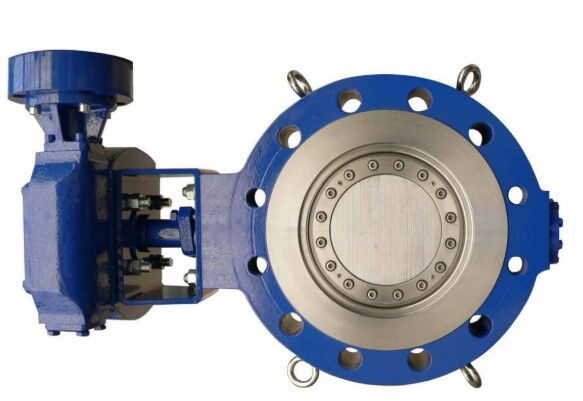
To overcome the shortcomings of traditional uni-directional sealing butterfly valves and meet the demand for bi-directional sealing in industrial systems, the triple-eccentric metal bi-directional sealing butterfly valve has emerged. This new type of butterfly valve incorporates multiple innovations in its design.
The disc sealing geometry of the triple-eccentric metal bi-directional sealing butterfly valve adopts a parabolic structure. This structure allows the wedge effect to occur on the disc regardless of whether the medium enters from the forward or reverse direction, enabling flexible contact of the sealing ring and achieving bi-directional sealing. This bi-directional sealing design greatly broadens the application scenarios of the butterfly valve, making it able to adapt to more complex conditions. For example, in pipeline systems with bi-directional flow, it can effectively prevent medium leakage.
The triple-eccentric metal bi-directional sealing butterfly valve replaces the traditional spherical sealing surface with an eccentric parabolic sealing surface. The curvature of the eccentric parabolic sealing surface is variable, and the direction of variation is opposite to the opening and closing direction of the disc. This design allows the disc to disengage or wedge into the seat more easily during operation. When the disc opens, the seat is relaxed and can float in the valve body groove. When the disc closes, the seat floats along with the disc into the optimal sealing position. Under the compression of the disc, the sealing force between the seat, the disc, and the valve gradually reaches its maximum, and the seat deforms into an elliptical shape. By determining the compression amount based on the sealing specific pressure and deriving the long axis b, the angular eccentricity a can be calculated. This structure not only achieves bi-directional sealing but also reduces the frictional torque of the seat and the radial eccentricity H2, thereby reducing the eccentric moment. Under the same operating conditions, the H2 eccentricity of the triple-eccentric metal bi-directional sealing butterfly valve is only 40%–60% of that of a uni-directional sealing butterfly valve, which reduces the torque on the valve shaft. Using the same materials and driving force, the triple-eccentric metal bi-directional sealing butterfly valve can meet higher process requirements than uni-directional metal-seated butterfly valves.
The floating structure of the triple-eccentric metal bi-directional sealing butterfly valve is another important feature. When the valve is closed, each cross-section of the seat is compressed by the disc and the valve, producing elastic deformation in two directions. The seat experiences outward tensile stress along the long axis and inward compressive stress along the short axis, resulting in elastic deformation in different directions. This structure allows stress effects to occur regardless of whether the medium enters from the forward or reverse direction, achieving sealing. This floating structure not only improves sealing performance but also extends the service life of the valve and reduces maintenance costs.
These innovative designs give the triple-eccentric metal bi-directional sealing butterfly valve multiple performance advantages.
The elastic metal sealing ring seat provides zero leakage performance. The parabolic seal ensures continuous bi-directional zero leakage. This means that in pipeline systems with bi-directional flow, the valve can effectively prevent medium leakage and ensure the safe operation of the system. This zero-leakage performance is extremely important for industrial systems with high sealing requirements, such as oil and gas or chemical industries.
The triple-eccentric parabolic disc geometry matches the valve’s opening and closing trajectory, making valve operation easier. The all-metal construction combined with zero-leakage performance gives the valve inherent fire safety features. The sealing surfaces of the butterfly disc are treated with ultra-hard coating for enhanced durability. These characteristics not only improve valve service life but also reduce operator effort and increase work efficiency.
The structure of the triple-eccentric metal bi-directional sealing butterfly valve allows it to adapt to complex conditions. For instance, during operation, seat corrosion and damage are inevitable. Ordinary butterfly valves require shutdown for maintenance and seat replacement. In contrast, the sealing circumference of the triple-eccentric valve’s seat increases with angular eccentricity a. When the seat is corroded or damaged, it is only necessary to adjust the closing position, increasing angular eccentricity a and the elastic compression of the seat. Through the opening and closing break-in between the disc and seat, seat damage can be eliminated. The floating seat ensures that after closing, the disc and seat are in the optimal sealing position, eliminating leakage. This self-compensating function greatly improves valve reliability and maintenance convenience.
These performance advantages allow the valve to be widely applied in various industrial fields.
During oil and gas extraction, transportation, and processing, pipelines must withstand high temperature, high pressure, and corrosive media. The bi-directional sealing performance and high-temperature, high-pressure resistance of the triple-eccentric metal bi-directional sealing butterfly valve effectively prevent oil and gas leakage, ensuring safe operation. At the same time, its zero-leakage performance and self-compensation function reduce maintenance costs and downtime, improving production efficiency.
In chemical production, pipelines often transport various corrosive media. The all-metal structure and ultra-hard coating of the triple-eccentric metal bi-directional sealing butterfly valve allow it to resist the erosion of corrosive media. Its bi-directional sealing performance and zero-leakage characteristics ensure the continuity and safety of chemical production while preventing environmental contamination caused by leaks.
In heating and water supply systems, pipelines require long-term stable operation. The low operating torque and durability of the triple-eccentric metal bi-directional sealing butterfly valve enable it to meet the long-term operation requirements of these systems. Its bi-directional sealing performance and zero-leakage characteristics ensure the quality and safety of heating and water supply while reducing energy waste and water loss.
During metallurgical production, pipelines must withstand high temperature, high pressure, and abrasive media. The high-temperature and high-pressure resistance, ultra-hard coating, and self-compensating seat of the triple-eccentric metal bi-directional sealing butterfly valve allow it to adapt to these harsh conditions. Its bi-directional sealing performance and self-compensation function enhance valve reliability, reduce maintenance costs, and ensure smooth metallurgical production.
As a new type of high-performance valve, the triple-eccentric metal bi-directional sealing butterfly valve, with its unique design and excellent performance, has been widely applied in the industrial field. It inherits the advantages of traditional uni-directional sealing butterfly valves and, on this basis, introduces innovations to achieve bi-directional sealing, reduce friction torque and eccentric moment, and improve sealing performance and reliability. Its zero-leakage performance, effortless operation, high-temperature and high-pressure resistance, and corrosion resistance enable it to adapt to various complex conditions and meet the high requirements of industrial systems for valves.
