Metal Seated Ball Valve Sealing Challenges & Solutions
In the field of industrial valves, metal seated ball valves are key equipment due to their exceptional sealing performance, broad applicability, and reliable durability. These valves play an essential role in a wide range of industrial scenarios, from low-temperature environments to high-pressure and high-temperature conditions, and from standard media to fluids with corrosive or abrasive properties. This article will focus on the sealing structure, characteristics, and performance of metal seated floating ball valves and metal seated trunnion ball valves in different application scenarios, helping you better understand the advantages and applications of these two types of ball valves.
In practical applications, metal seated ball valves face numerous challenges, with the key issues being:
During the opening and closing process, the ball and metal seat sealing surfaces inevitably experience friction. This friction not only increases the operating torque but can also cause wear on the sealing surfaces, which may affect the valve’s sealing performance and lifespan. To address this, both metal seated floating ball valves and metal seated trunnion ball valves adopt special structural designs and material selections to reduce the friction coefficient and improve the wear resistance of the sealing surfaces.
At high or low temperatures, the components of the valve may undergo thermal expansion or contraction. If these deformations are not properly controlled, the ball and seat may become stuck, preventing the valve from operating correctly. Metal seated floating ball valves use spring-loaded structures, such as plate springs or compression springs, to absorb the deformation of the valve body, ball, and seat, ensuring that the valve remains operable at extreme temperatures.
The wear and corrosion resistance of the sealing components of the ball valve are crucial factors in ensuring long-term stable operation. In harsh conditions such as environments with solid particles, fibers, or corrosive media, the choice of materials and surface treatments for the sealing surfaces becomes particularly important. By selecting appropriate materials and employing special surface treatments for the ball and seat sealing surfaces, metal seated ball valves can effectively resist wear and corrosion, thus extending their service life.
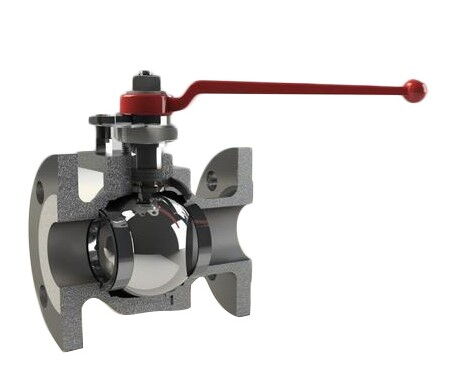
Metal seated floating ball valves are widely used due to their structure and working principle, which perform well in various conditions.
- Structural Composition: Metal seated floating ball valves mainly consist of the valve body, valve cover, ball, seat, valve stem, spring, and gasket. These valves typically use an outlet-end sealing structure, with the inlet-end seat utilizing a spring-loaded structure (plate spring or compression spring), and no sealing element is placed between the seat and the valve body.
- Working Principle: Under both high and low-temperature conditions, the deformation of the valve body, ball, and seat is absorbed by the spring, preventing the ball from becoming stuck due to thermal expansion or contraction. When the valve is closed, the spring force and the medium pressure work together to push the ball against the outlet seat, ensuring a good sealing effect between the seat and ball, as well as between the seat and valve body, under both low and high-pressure conditions. In low-pressure situations, the spring load plays a key role in ensuring the sealing performance.
- Major Characteristics: Metal seated floating ball valves feature low operating torque, making valve operation easier. By selecting different materials and performing special surface treatments on the ball and seat sealing surfaces, these valves ensure reliable sealing and possess high-temperature, wear-resistant, and corrosion-resistant characteristics, resulting in a long service life. Additionally, metal seated floating ball valves perform excellently under extreme conditions such as ultra-high pressure, dust, and media containing solid particles or fibers. The good shearing and self-cleaning function between the ball and seat make them ideal for controlling media with particles and fibers.
- Main Applications: Metal seated floating ball valves are suitable for various conditions, including media cutoff control in low and high-temperature environments. In low-temperature applications, the media temperature can reach as low as -196°C, and the valve body and internal components are cryogenically treated with liquid nitrogen and equipped with extended valve covers to ensure normal operation at ultra-low temperatures with zero leakage. In high-temperature applications, media temperature can reach +650°C, with the valve body and internal parts made from special high-temperature alloy steel and treated with specific heat treatment, along with extended heat-dissipating valve covers, ensuring normal operation in high-temperature conditions with zero leakage. Metal seated floating ball valves are also widely used in the main steam system of thermal power generation units, where they are used to discharge steam condensate during shutdowns, preventing corrosion damage to high-temperature, high-pressure pipelines and related equipment.
Metal seated trunnion ball valves have a structure similar to metal seated floating ball valves, consisting of the valve body, valve cover, ball, seat, valve stem, spring, gasket, and other components. However, metal seated trunnion ball valves typically select inlet-end sealing structures based on pressure, medium properties, and sealing requirements. While the structure and working principle of metal seated trunnion ball valves differ from metal seated floating ball valves, they can also meet a variety of industrial needs.
The seat sealing can be chosen based on the operating temperature, selecting from O-ring seals, graphite gaskets, or pressure self-tightening graphite seals. These sealing structures can be reasonably selected according to the actual working conditions to achieve satisfactory sealing performance. Metal seated trunnion ball valves generally use a ball-front sealing structure and feature double isolation and double venting (QBB structure). The sealing principle is detailed in the valve design manual.
One structure is the graphite gasket or pressure self-tightening seal. When the valve is closed, the sealing between the seat and valve cover is ensured by the seal ring, using the pressure self-tightening sealing principle. When the medium pressure is absent in the valve cavity, the pre-tightening force generated by the spring acts on the pressure ring, creating initial sealing conditions between the seal ring, valve body, and seat. As the medium pressure increases in the valve cavity, the piston effect of the seat compresses the seal ring, increasing the sealing pressure as the pressure rises. At the same time, the seat sealing surface remains in close contact with the ball, ensuring that the valve achieves leak-tight sealing under both high and low-pressure differences. If the pressure in the valve cavity rises abnormally, the outlet seat will automatically vent the pressure downstream.
Another structure is the O-ring seal. When the valve is closed, the sealing between the inlet-end seat and valve cover is ensured by the O-ring. The medium pressure acting on the seat generates a piston effect, pushing the seat into tight contact with the ball. If the medium pressure in the valve cavity rises abnormally, the outlet seat will automatically vent the pressure downstream under the action of the internal cavity pressure.
Metal seated trunnion ball valves feature high corrosion and wear resistance, meeting the demands of complex working conditions. Their sealing structure is well-designed to maintain reliable sealing performance under varying pressure and temperature conditions. Additionally, metal seated trunnion ball valves offer automatic pressure venting functionality, effectively protecting the valve and related equipment in case of abnormal pressure rise in the valve cavity.
Metal seated trunnion ball valves are widely used in various fields. For example, in domestic coal-to-oil methanol projects, high-pressure oxygen cutoff is a critical part, with pressure ranges of 2.0 to 5.0 MPa. Due to the special properties of oxygen, its flow rate must be controlled within a certain range. Therefore, a high-pressure oxygen cutoff-type metal seated ball valve was specifically improved, with internal components made of special alloys such as MONEL, ensuring that the valve controls the oxygen flow rate to below 25 m/s at the moment of opening, with zero leakage, meeting national standards and user requirements. With the large-scale development of coal-to-oil projects and methanol projects in China, high-pressure oxygen cutoff valves have been widely used in these plants, breaking the previously complete reliance on imports.
Moreover, metal seated trunnion ball valves are extensively used in high-temperature, high-pressure steam cutoff applications, such as the main steam discharge piping of large petrochemical plants. In these conditions, media temperatures range from 300°C to 500°C, and pressure is 3.0 to 5.0 MPa, with valve diameters ranging from DN200 to DN600. Due to factors such as high temperature, high pressure, and large diameter, special grinding equipment and techniques were adopted to successfully address the difficulty of grinding large-diameter ball valves, ensuring normal operation under high-temperature and high-pressure conditions, with zero leakage.
To better understand the characteristics and applications of metal seated floating ball valves and metal seated trunnion ball valves, we can compare them based on the following aspects:
- Sealing Structure: Metal seated floating ball valves use an outlet-end sealing structure with spring-loaded seats at the inlet, while metal seated trunnion ball valves use various sealing methods (O-rings, graphite gaskets, or pressure self-tightening seals) at the inlet, depending on pressure, medium, and sealing requirements.
- Operating Torque: Metal seated floating ball valves have lower operating torque, making opening and closing easier. In contrast, metal seated trunnion ball valves may have slightly higher operating torque, but with reasonable design and material selection, the torque can be kept within a manageable range.
- Suitable Working Conditions: Metal seated floating ball valves are suitable for various conditions, including low temperatures (-196°C) and high temperatures (+650°C), as well as media cutoff control in thermal power plant steam systems. Metal seated trunnion ball valves are ideal for high-pressure oxygen cutoff (2.0 to 5.0 MPa) and high-temperature, high-pressure steam cutoff (300°C to 500°C) in complex environments, such as coal-to-oil and methanol projects, and large petrochemical plants.
- Sealing Performance: Both valve types offer excellent sealing performance and achieve zero leakage under both low and high-pressure conditions. Metal seated floating ball valves achieve sealing through spring force and medium pressure, while metal seated trunnion ball valves rely on O-ring seals, graphite gaskets, or self-tightening graphite seals, with automatic pressure venting to ensure safety under abnormal conditions.
Metal seated ball valves play a crucial role across various industries. Metal seated floating ball valves and metal seated trunnion ball valves, as the two primary types, each have unique structures, characteristics, and application scopes. Metal seated floating ball valves excel in low torque, good sealing performance, and wide applicability in extreme conditions, while metal seated trunnion ball valves, with their high corrosion resistance, wear resistance, and automatic pressure venting, are especially effective in high-pressure oxygen cutoff and high-temperature, high-pressure steam cutoff applications.
