What Affect the Sealing Performance of Trunnion Ball Valves
In industrial pipeline systems, ball valves serve as critical shut-off devices, and their sealing performance directly determines the safety and reliability of the entire piping network. Thanks to their distinctive structural advantages, trunnion ball valves perform exceptionally well under demanding conditions such as high pressure, high temperature, and large diameters. However, achieving true zero leakage requires overcoming a series of technical challenges, from ball machining and seat manufacturing to assembly and commissioning. This article systematically analyzes the key factors that influence the sealing performance of trunnion ball valves and explores how modern manufacturing technologies enhance product quality.
The core sealing mechanism of a trunnion ball valve is based on mechanical force balance. When the ball is in the closed position, the thrust generated by the seat spring presses the sealing surface firmly against the ball, forming a reliable sealing pair. Specifically, the sealing force depends on the distribution of force acting on the spherical area defined by the outer diameter of the seat sealing surface and the spherical sealing line.
Sealing reliability largely depends on the ratio between the sealing medium pressure (pMP) and the seat diameter (Dm). This ratio must be precisely controlled. If the contact area between the sealing surface and the ball is too small, reliable sealing cannot be ensured; if it is too large, the seat and sealing ring may be overloaded, increasing operating torque and accelerating wear of the sealing surfaces. Therefore, determining the optimal contact area through accurate calculations is essential during the design stage.
Trunnion ball valves are mainly available in two structural configurations: upstream sealing (inlet sealing) and downstream sealing (outlet sealing). In high-pressure applications or systems with a nominal diameter of DN ≥ 200 mm, the trunnion-mounted design is widely adopted. Unlike floating ball valves, the ball in a trunnion valve does not shift under pressure. This feature provides two major advantages: true bidirectional sealing and reduced operating torque, while maintaining relatively stable loads on the seats.
Trunnion ball valves also offer multiple safety features, including low operating torque, fast opening and closing, a low flow resistance coefficient, and functions such as fire protection, anti-static performance, and automatic cavity pressure relief. These characteristics make them particularly suitable for high-pressure, high-temperature, large-diameter pipeline systems in industries such as natural gas transmission, oil storage, chemical processing, metallurgy, urban infrastructure, and environmental protection.
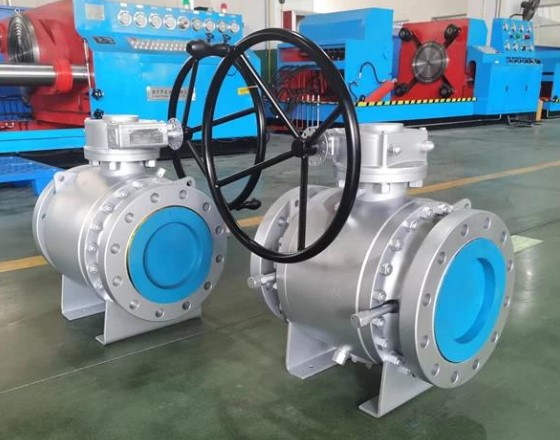
As the primary closure component, the geometric precision and surface quality of the ball directly determine the effectiveness of the sealing pair. Any deviation generated during machining can be amplified during assembly, ultimately leading to sealing failure or abnormal operating torque. Therefore, controlling ball machining accuracy is the first critical step in preventing valve leakage.
The precision of the shaft holes is a key factor affecting sealing performance. Traditional machining methods often rely on marking lines and boring the shaft holes accordingly. However, this approach has a fundamental flaw: the ball is not positioned according to its actual working orientation inside the valve during machining, resulting in significant errors that make it difficult to meet drawing requirements. The accumulated errors after assembly can severely compromise sealing effectiveness and are a major cause of valve leakage.
Field measurements show that coaxiality errors produced by line-marking correction methods can reach up to 6 mm. Poor coaxiality between the upper and lower shaft holes can cause interference between the shafts and composite bearings during assembly. To eliminate this interference, operators may be forced to increase the radial dimensions of the bearings, which directly creates gaps between the ball and the seat. While valves using soft sealing materials such as rubber or PTFE may still achieve leak-free performance, this comes at the cost of higher operating torque and accelerated seal wear. For metal-seated ball valves, such machining errors make zero leakage virtually impossible.
Modern machining processes provide an effective solution. After finish machining, the shaft holes should be processed on CNC or digital boring machines. The high spindle accuracy of these machines allows precise identification of the ball center. The recommended procedure is to machine one shaft hole first, then rotate the boring table exactly 180 degrees and re-align the spindle before machining the opposite hole. This method ensures high positional accuracy and minimizes coaxiality error, eliminating sealing failures caused by shaft misalignment at the source.
As a core sealing component, the ball’s surface quality directly affects sealing reliability. Balls are typically made from 1Cr18Ni9Ti stainless steel or carbon steel with a chrome-plated surface. However, structural features such as flow passages and shaft holes create sharp edges. According to electroplating principles, current density concentrates at sharp edges, resulting in significantly thicker plating in these areas, often with deviations exceeding 30% from the average thickness.
Even if the ball is ground after turning, uneven plating thickness can cause out-of-tolerance roundness. This issue is particularly critical for metal-seated valves, as it can create leakage paths between the seat and the ball, preventing proper sealing after assembly.
Strict process control is therefore essential. First, the plating thickness should be limited to within 0.03 mm. Second, the ball must be reground after plating to remove excess metal and restore geometric accuracy. Balls treated with this process can meet drawing requirements for roundness and surface roughness and comply with API inspection standards. Furthermore, combining a power-head-modified grinding device with a spherical lathe to create an integrated turning–grinding–lapping machine makes it entirely feasible to achieve gas-tight sealing in metal-seated ball valves.
Precision Machining of the Seat Sealing Surface: The 90-degree conical surface of the seat is the critical interface that forms the seal with the ball. Traditional methods use three-jaw or four-jaw chucks, but these approaches often produce uneven roundness due to heavy machining at the clamping points, compromising geometric accuracy. An improved process involves pressing the workpiece for clamping. During the final finishing stage, the pressing plate should first be loosened and then gently re-tightened to eliminate clamping deformation. After machining, the ball and seat should undergo matched lapping to achieve a surface roughness of Ra 0.8 μm while ensuring the roundness of the 90-degree cone. This guarantees precise mating between the ball and seat and ensures leak-free sealing.
Proper Selection of O-Ring Pre-Compression: The pre-compression of the O-ring is a critical parameter influencing sealing performance and service life. For static seals, the pre-compression is typically 0.25d (where d is the O-ring cross-sectional diameter); for dynamic seals, it should be 0.15d. In trunnion ball valves, the O-ring pre-compression should follow the dynamic seal value of 0.15d. However, many designs currently specify excessive pre-compression, which increases friction, accelerates seal wear, and reduces valve lifespan. Proper control requires precise calculation during the design phase and strict management during assembly.
Although rigid seats feature simple structures, they exhibit clear limitations in practical applications. As industrial operating conditions grow more demanding, particularly with increasing exposure to high pressure, high temperature, and corrosive media, traditional rigid sealing designs struggle to meet requirements for long service life and low maintenance. Introducing elastic elements and composite structural designs has therefore become an important direction for improving trunnion ball valve reliability.
To ensure sealing under low working pressure, a certain preload specific pressure must exist between the ball and seat. In rigid seat designs, reliability and service life largely depend on selecting the correct pre-compression.
Insufficient pre-compression cannot guarantee sealing at low pressure, while excessive pre-compression increases friction torque, impairs valve operation, and may even cause plastic deformation of the seat, ultimately leading to sealing failure. For PTFE seats, the preload specific pressure should generally be 0.1PN (PN = nominal pressure) and not less than 1.02 MPa.
Adjustment of pre-compression relies on changing the thickness of sealing shims. However, machining errors in the shims affect adjustment accuracy, and proper assembly is critical to achieving effective sealing. A more prominent drawback is the poor automatic compensation for preload after seat wear, resulting in a relatively shorter service life for valves with rigid seat structures.
An effective solution is to adopt seat structures incorporating elastic elements. In such designs, preload is obtained and adjusted through components such as disc springs or cylindrical coil springs rather than sealing shims.
This approach offers significant advantages. It provides the necessary preload and, more importantly, allows automatic compensation of preload within the elastic deformation range. When seat wear occurs, the elastic force maintains sufficient sealing pressure, extending the valve’s service life.
Disc springs and coil springs are already widely used in valves handling non-corrosive media. However, their application in highly corrosive environments is limited because it is difficult to select materials that simultaneously offer strong corrosion resistance and good elasticity, and the heat treatment processes for such materials are complex.
For highly corrosive media, a composite sealing structure combining an elastic expansion ring with a PTFE lip seal can be adopted. The expansion ring may be made from austenitic stainless steels such as 1Cr18Ni9Ti or 1Cr18Ni9, which provide excellent corrosion resistance and compatibility with aggressive media.
Structurally, the PTFE lip seal is designed with a 30-degree lip angle, while the expansion ring uses a 34-degree angle, creating a 4-degree difference. Under medium pressure, the elastic force of the expansion ring compensates for the limited elastoplastic deformation capacity of PTFE alone, thereby improving sealing reliability and extending service life.
At low medium pressure, the angle difference, combined with the strong elastoplastic deformation capability of the metal ring, causes the PTFE lip to expand outward and press tightly against the ball, generating preload that compensates for reduced sealing pressure. As long as the force remains within the elastic range of the expansion ring, reliable sealing can be maintained even under low-pressure conditions.
Trunnion ball valves are products with demanding machining and assembly requirements, and their sealing performance is influenced by multiple interrelated factors. From controlling shaft hole coaxiality and plating accuracy to ensuring seat cone machining quality, selecting proper O-ring pre-compression, and optimizing seat structure design, every stage requires strict process control and quality assurance.
Advancements in modern manufacturing technologies provide strong support for improving valve quality. CNC machining significantly enhances shaft hole precision; advanced electroplating and grinding technologies ensure the geometric accuracy of the ball; and innovative composite sealing designs expand the applicability of ball valves in severe operating environments.
Only by integrating materials science, precision manufacturing, and engineering design can the industry truly achieve long service life and zero leakage in trunnion ball valves, providing a solid guarantee for the safe operation of industrial pipeline systems.
