Installation Guide for Double Eccentric Butterfly Valves
Double eccentric butterfly valves play a critical role in pipeline systems by isolating media and regulating flow. Compared with other types of valves, they impose more stringent requirements on installation techniques. Featuring a single-direction sealing design, these valves are highly sensitive to installation errors. Incorrect flow direction, improper welding procedures, or an incorrect bolt-tightening sequence can all lead to poor sealing, leakage, or even equipment damage. In many cases, valve failures observed on site are not caused by product quality issues, but by oversights during installation.
This guide provides a comprehensive explanation of the entire installation process for double eccentric butterfly valves. From pre-installation preparation and detailed operating steps to flow direction identification and welding protection measures, it is intended to help engineers and technicians master correct installation practices and ensure that the valve delivers its designed sealing performance and service life once in operation.
Before starting the installation of a double eccentric butterfly valve, thorough site preparation is essential. These preparatory steps may appear simple, but they form the foundation for ensuring installation quality.
First, the valve body must be thoroughly cleaned. During transportation, the valve may be subjected to impact or compression, and components such as the disc and sealing surfaces may develop scratches, dents, or contamination. Installers should carefully inspect whether the sealing surfaces are intact and remove any defects or contaminants caused during transport. The sealing surfaces must be clean and free of foreign matter, as even minor debris or damage can result in sealing failure after installation.
Next, carefully check the markings on the valve. Double eccentric butterfly valves are directional valves, and arrows marked on the valve body indicate the media flow direction and sealing direction. Before installation, it is essential to confirm that the pipeline’s design flow direction matches the direction indicated on the valve. A common cause of installation errors is relying on experience or assumptions about supply and return lines instead of strictly following the valve markings. Installation should only proceed after the marked flow direction fully matches the actual pipeline requirements.
At the same time, verify that the valve size, model, and specifications comply with the design drawings, confirm that flange dimensions are compatible, and check that the actuator configuration is correct. For valves equipped with actuators, ensure that the actuator is intact in appearance and that the limit settings are in normal condition.
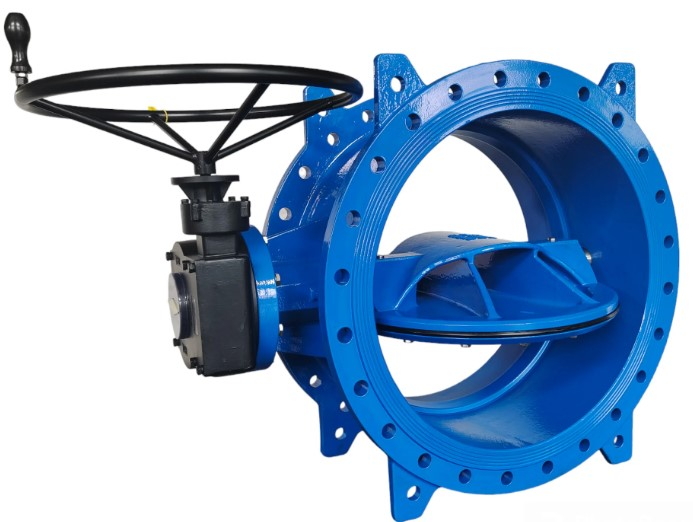
The installation direction of a double eccentric butterfly valve is the most critical aspect of the entire installation process. Due to its single-direction sealing design, the eccentric interaction between the disc and the seat can only achieve optimal sealing performance in a specific direction. Incorrect installation orientation will significantly reduce sealing performance, leading to internal leakage and, in severe cases, affecting maintenance operations and emergency handling of the entire pipeline network.
Double eccentric butterfly valves are typically marked with an arrow on the valve body, indicating the sealing direction. For double eccentric valves with bidirectional sealing capability, the arrow usually points to the primary sealing direction. In practical terms, this can be simply remembered as: the arrow should point toward the drainage or pressure-relief side, which is typically the side used for maintenance.
In heating systems with supply and return pipelines, it is recommended that the arrows on all butterfly valves point toward the commonly serviced pressure-relief end. With this orientation, system pressure acts on the valve disc in a way that reinforces the sealing force, ensuring tighter shutoff when the valve is closed. Installing the valve arbitrarily based on pipe routing or aesthetic considerations may lead to poor sealing and ineffective isolation during maintenance.
In addition to correct flow direction, the valve’s installation orientation on the pipeline is also clearly defined. Where conditions permit, butterfly valves should preferably be installed on vertical pipelines. Vertical installation facilitates the passage of solid particles in the fluid, preventing sediment accumulation around the valve.
If horizontal installation is unavoidable, the valve shaft should not be installed vertically. The preferred configuration is to install the shaft horizontally. In special cases where neither vertical nor horizontal shaft orientation is feasible, inclined installation is permitted, but the inclination angle must not exceed 45 degrees. These requirements are intended to prevent solid impurities from accumulating beneath the disc, which could cause jamming, incomplete closure, or operational difficulties.
Double eccentric butterfly valves are typically connected by flanges. Improper welding of the flanges to the pipeline can subject the valve to excessive heat, resulting in serious damage.
The correct procedure is to weld the flanges to the pipeline first, then allow them to cool naturally to ambient temperature before installing the valve. This cooling period must not be omitted. The high temperatures generated during welding are conducted through the flanges; installing the valve while the flanges are still hot can transfer heat to the valve’s resilient seat, causing thermal deformation, aging, or degradation of rubber, graphite, or other sealing materials. This directly affects sealing performance and service life.
After welding, the flange welding edges must be machined on a lathe until the surfaces are smooth. Welding slag, burrs, and uneven areas must be completely removed. Otherwise, these sharp edges may scratch or compress the resilient valve seat during installation, causing permanent damage to the sealing surface.
Before connecting the valve, the flange faces must be intact and free from deformation. Thoroughly remove dirt, dust, and foreign matter from the flange surfaces, and clean the inside of the pipeline to eliminate welding spatter, scale, and other debris. If such contaminants enter the sealing area, they can cause leakage or abrasive damage to the sealing surfaces during operation.
Proper pipeline alignment is critical for reliable valve performance. During installation, ensure that the centerlines of the upstream and downstream pipelines are precisely aligned. Misalignment or distortion will impose additional stress on the valve after installation, compromising sealing performance, increasing operating torque, and potentially causing stem deformation or bearing damage during long-term operation.
The installation of a double eccentric butterfly valve must strictly follow specified technical steps, particularly with respect to valve opening position and bolt tightening methods.
At the beginning of installation, place positioning bolts beneath the pipeline and adjust them to the same height to temporarily support the valve. Then adjust the distance between the two flanges so that a clearance of 6–10 mm is maintained between the valve body and each flange. This clearance provides room for subsequent alignment and tightening adjustments.
At this stage, the valve must be in the closed position, and the disc should only be opened to about 10 degrees. Within the 0–10 degree opening range, the upper and lower sealing surfaces of the disc are still in contact with the valve seat. If the opening angle is too large, the disc may interfere with or collide with the inner diameter of the flange, damaging the sealing surfaces.
Insert two bolts into the guide holes on the lower side of the valve and slowly draw the flanges toward the valve, taking care not to damage the resilient seat. Then insert the remaining two bolts into the upper guide holes to preliminarily secure the valve and ensure accurate centering between the valve and the pipeline.
After preliminary fixation, manually open and close the valve three times to check whether the disc contacts or rubs against the inner diameter of the flanges during rotation. Once no interference is confirmed, remove the temporary positioning bolts and insert all remaining bolts evenly around the flange holes.
Bolts must be tightened in a diagonal, alternating sequence, tighten one bolt, then the bolt opposite it, gradually and evenly until the flange faces fully contact the valve body. Sequential clockwise or counterclockwise tightening is prohibited, as it can cause uneven stress and flange deformation, resulting in poor sealing. During tightening, refer to the manufacturer’s specified torque values and use a torque wrench. Excessive torque may crush the resilient seat, while insufficient torque will fail to provide adequate sealing pressure.
When welding operations and large valve installations are involved, dedicated protective measures are essential to prevent mechanical and thermal damage.
If welding must be performed on pipelines with the valve already installed, special attention must be paid to the grounding of the welding machine. The grounding cable must be connected to the steel pipe on the same side of the weld joint, ensuring that the welding current forms a closed circuit only within the pipeline. Under no circumstances should welding current pass through the valve body. If current flows through the valve, arc damage may occur on the sealing surfaces, creating pits or burn marks that are usually irreparable and can render the valve unusable.
For double eccentric butterfly valves welded onto vertical pipelines, water with a height of at least 10 mm should be poured above the closed valve disc prior to welding. This water layer acts as a thermal buffer, absorbing heat generated during welding and protecting the disc and sealing materials. For valves installed horizontally, wet cloths should be wrapped around the valve body to provide cooling and prevent welding spatter from directly contacting the valve surface.
For double eccentric butterfly valves with nominal diameters of DN350 or larger, the large weight and dimensions require special care during installation. Inverted installation is strictly prohibited. Handling and lifting must be stable and controlled to avoid impact. When installing actuators, provide independent support structures so that the actuator weight and pipeline stress are not entirely borne by the valve neck, preventing deformation. Such support also reduces frictional stress between the valve and connected piping.
Installation personnel must not stand or step on the valve neck or handwheel, as concentrated loads can bend the stem or displace sealing components. High-performance double eccentric butterfly valves should not be installed directly downstream of check valves or pump outlets, since high-velocity media during opening may cause the disc to collide with adjacent components, resulting in structural damage.
The installation of double eccentric butterfly valves involves multiple critical steps, including flow direction determination, welding protection, precise alignment, and proper bolt tightening. Each step has clear technical requirements, and any oversight may result in sealing failure or premature valve damage. Installers must recognize that the single-direction sealing nature of the double eccentric design makes correct flow orientation essential, while thermal and electrical protection during welding are key to preventing irreversible damage.
By strictly following pre-installation cleaning and inspection procedures, adhering to the correct sequence for flange welding and valve installation, implementing necessary protective measures, and completing thorough post-installation commissioning, double eccentric butterfly valves can achieve their designed sealing performance and service life. Standardized installation practices are not only a technical requirement, but also a fundamental guarantee for safe pipeline operation and the maximization of equipment investment value.
